Loading…
QCE Physics external exam
2023, Paper 1
20 multiple-choice and 8 short-response questions, 46 marks, 90 minutes.
90:00
Nothing marked yet · paper out of 46In the exam room: 10 minutes of perusal (reading, no writing), then 90 minutes of working time. Calculator and formula book allowed. The timer counts the working time.
Section 1: Multiple choice
Choose the best answer for each question, then mark the section.
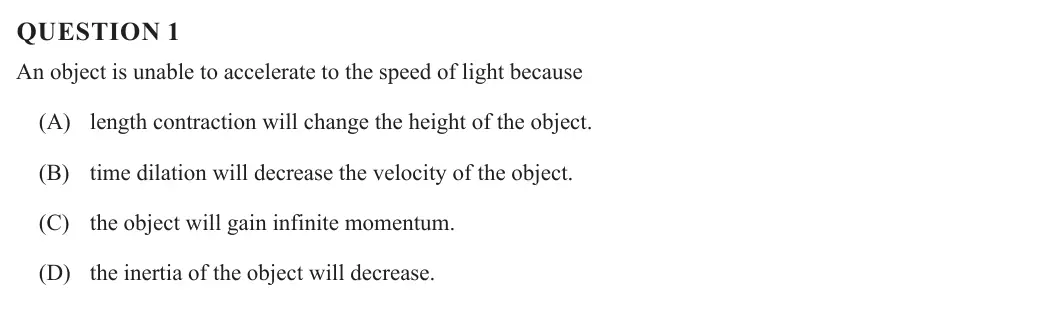
QUESTION 1 An object is unable to accelerate to the speed of light because (A) length contraction will change the height of the object. (B) time dilation will decrease the velocity of the object. (C) the object will gain infinite momentum. (D) the inertia of the object will decrease.
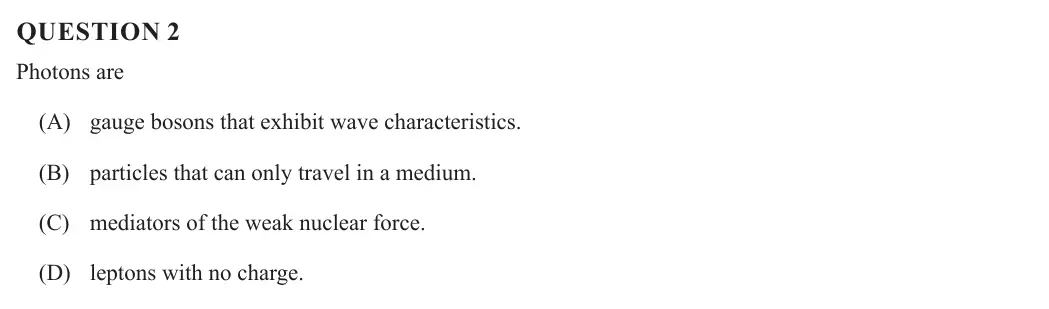
QUESTION 2 Photons are (A) gauge bosons that exhibit wave characteristics. (B) particles that can only travel in a medium. (C) mediators of the weak nuclear force. (D) leptons with no charge.
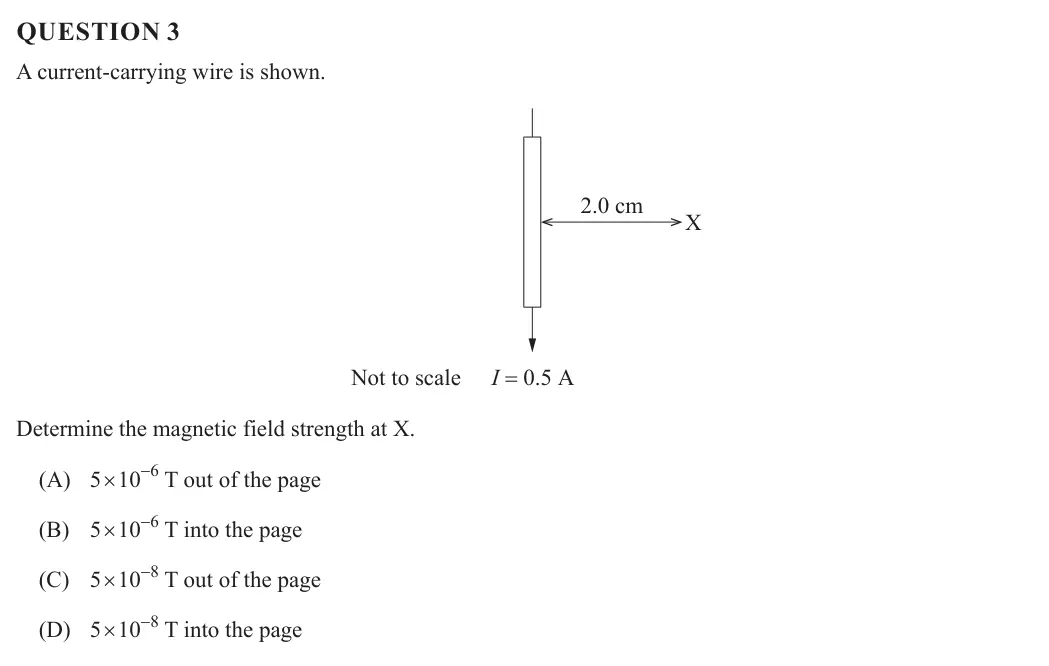
QUESTION 3 A current-carrying wire is shown. 2.0 cm X I = 0.5 A Not to scale Determine the magnetic field strength at X. (A) 5 × 10⁻⁶ T out of the page (B) 5 × 10⁻⁶ T into the page (C) 5 × 10⁻⁸ T out of the page (D) 5 × 10⁻⁸ T into the page
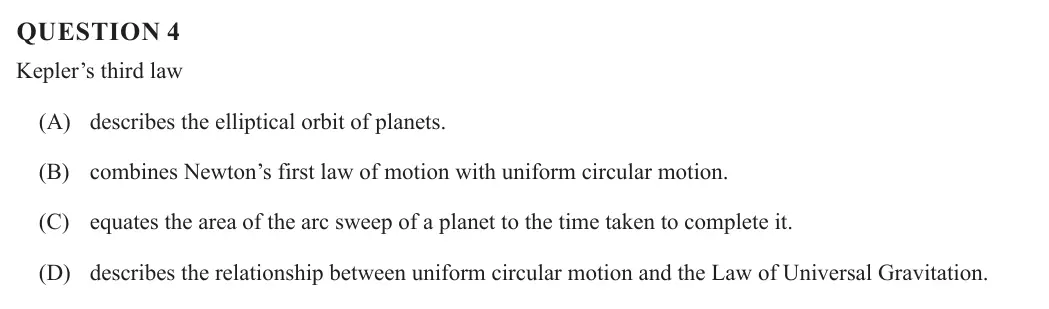
QUESTION 4 Kepler’s third law (A) describes the elliptical orbit of planets. (B) combines Newton’s first law of motion with uniform circular motion. (C) equates the area of the arc sweep of a planet to the time taken to complete it. (D) describes the relationship between uniform circular motion and the Law of Universal Gravitation.
QUESTION 5 Young’s double slit experiment demonstrates that light (A) behaves differently in different frames of reference. (B) shares characteristics with mechanical waves. (C) is a longitudinal wave. (D) acts like a particle.
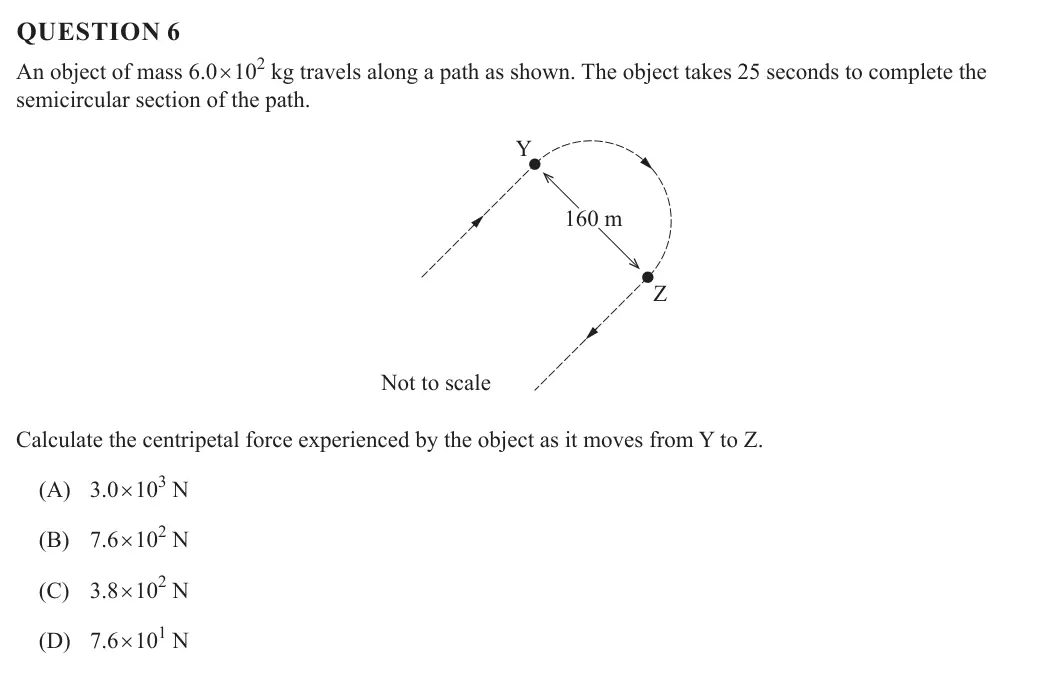
QUESTION 6 An object of mass 6.0 × 10² kg travels along a path as shown. The object takes 25 seconds to complete the semicircular section of the path. 160 m 160 m Y Z Not to scale Calculate the centripetal force experienced by the object as it moves from Y to Z. (A) 3.0 × 10³ N (B) 7.6 × 10² N (C) 3.8 × 10² N (D) 7.6 × 101 N
QUESTION 7 An electron and positron can annihilate into a photon, producing another electron and positron pair in the process. An outcome of this interaction is that (A) total mass decreases. (B) fewer baryons will be produced. (C) the lepton number does not change. (D) the number of particles will decrease.
QUESTION 8 Incident light with a frequency of 1.70 × 10¹⁵ Hz is shone onto a metal surface with a work function of 1.00 × 10⁻¹⁸ J. Determine the kinetic energy of a photoelectron ejected from the metal surface. (A) 7.9 × 10⁻¹ eV (B) 1.7 × 10⁻¹⁵ eV (C) 1.3 × 10⁻¹⁹ eV (D) 2.0 × 10-38 eV
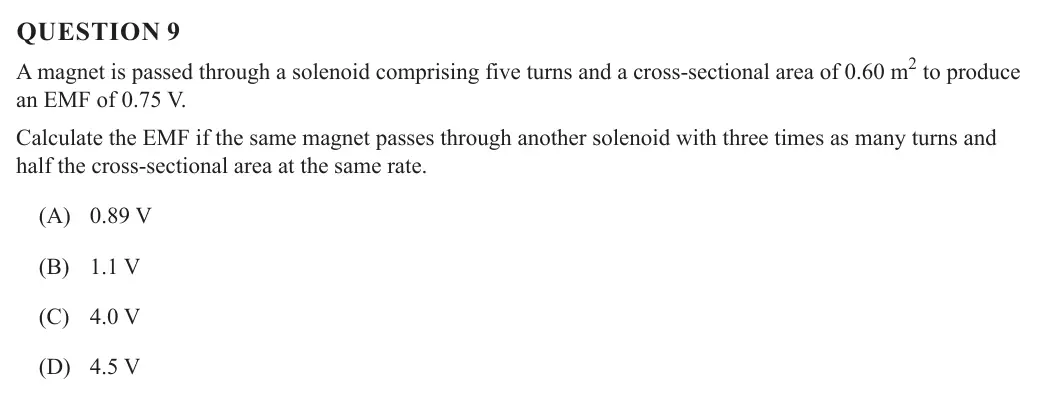
QUESTION 9 A magnet is passed through a solenoid comprising five turns and a cross-sectional area of 0.60 m2 to produce an EMF of 0.75 V. Calculate the EMF if the same magnet passes through another solenoid with three times as many turns and half the cross-sectional area at the same rate. (A) 0.89 V (B) 1.1 V (C) 4.0 V (D) 4.5 V
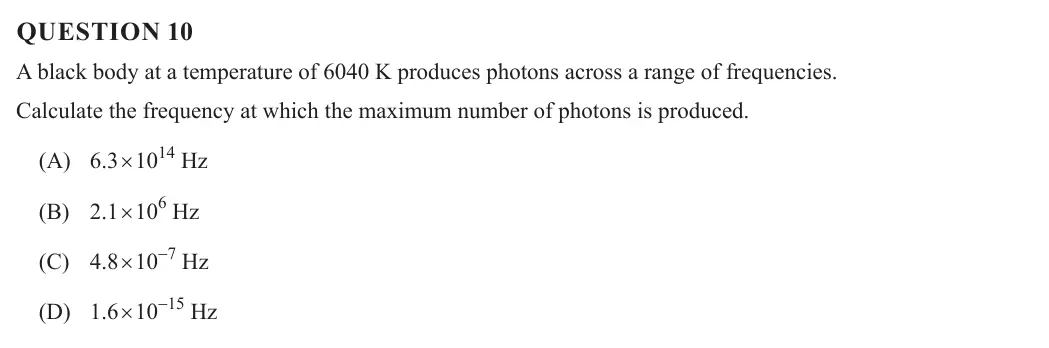
QUESTION 10 A black body at a temperature of 6040 K produces photons across a range of frequencies. Calculate the frequency at which the maximum number of photons is produced. (A) 6.3 × 10¹⁴ Hz (B) 2.1 × 10⁶ Hz (C) 4.8 × 10⁻⁷ Hz (D) 1.6 × 10⁻¹⁵ Hz
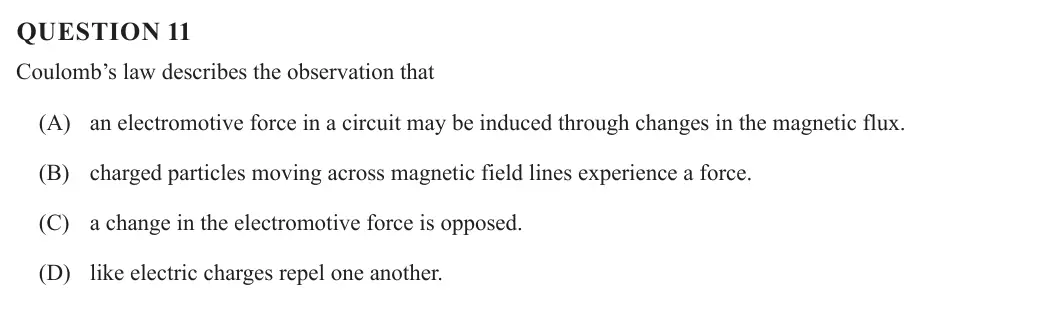
QUESTION 11 Coulomb’s law describes the observation that (A) an electromotive force in a circuit may be induced through changes in the magnetic flux. (B) charged particles moving across magnetic field lines experience a force. (C) a change in the electromotive force is opposed. (D) like electric charges repel one another.
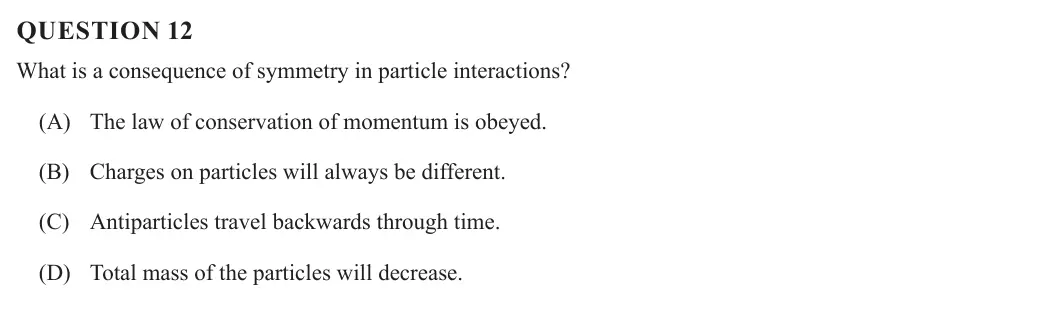
QUESTION 12 What is a consequence of symmetry in particle interactions? (A) The law of conservation of momentum is obeyed. (B) Charges on particles will always be different. (C) Antiparticles travel backwards through time. (D) Total mass of the particles will decrease.
QUESTION 13 A magnet moving through a coil of wire will induce a current with a magnetic field (A) parallel to the electric field. (B) opposite in direction to the change in flux. (C) inversely proportional to the electromotive force. (D) that will continue to fluctuate once the magnet is removed.
QUESTION 14 An electron is best described as a (A) lepton with a larger mass than a positron. (B) baryon with a smaller mass than a proton. (C) meson that experiences the strong nuclear force. (D) particle whose interactions can be mediated by photons.
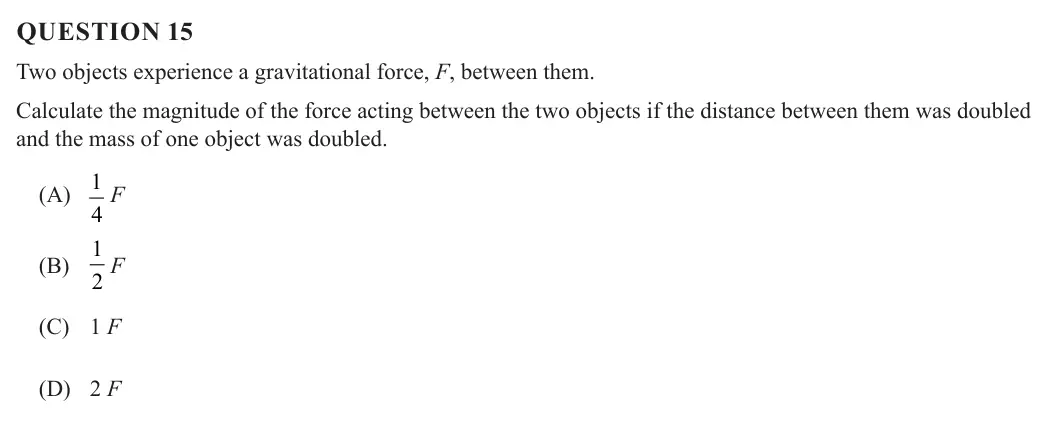
QUESTION 15 Two objects experience a gravitational force, F, between them. Calculate the magnitude of the force acting between the two objects if the distance between them was doubled and the mass of one object was doubled. (A) 1 4 F (B) 1 2 F (C) 1 F (D) 2 F
QUESTION 16 A train is travelling at relativistic speed and is about to move through a tunnel. An observer on the train measures the train and tunnel to each be 95 m long. A second observer is stationary relative to the tunnel. They would observe the train to (A) simultaneously enter and exit the tunnel. (B) decrease its mass while in the tunnel. (C) move faster while in the tunnel. (D) be shorter than the tunnel.
QUESTION 17 The half-life of an unstable subatomic particle is measured by a stationary detector to be longer when its velocity approaches the speed of light. This is because the particle (A) is moving relative to its frame of reference. (B) is in the same frame of reference as the detector. (C) experiences time differently relative to the detector. (D) cannot be accurately observed at relativistic speeds.
QUESTION 18 A 20 kg object is placed on an inclined plane with a slope of 35°. If the object experiences a frictional force of 40 N and no additional applied force, calculate its acceleration down the inclined plane. (A) 3.6 m s-2 (B) 5.6 m s-2 (C) 6.0 m s-2 (D) 7.6 m s-2
QUESTION 19 Calculate the electric field strength experienced at a distance of 2.8 ×10⁻¹¹ m from the centre of a helium nucleus. (A) 1.0 ×10² N C-1 (B) 2.0 ×10² N C-1 (C) 3.7 ×10¹² N C-1 (D) 7.3 ×10¹² N C-1
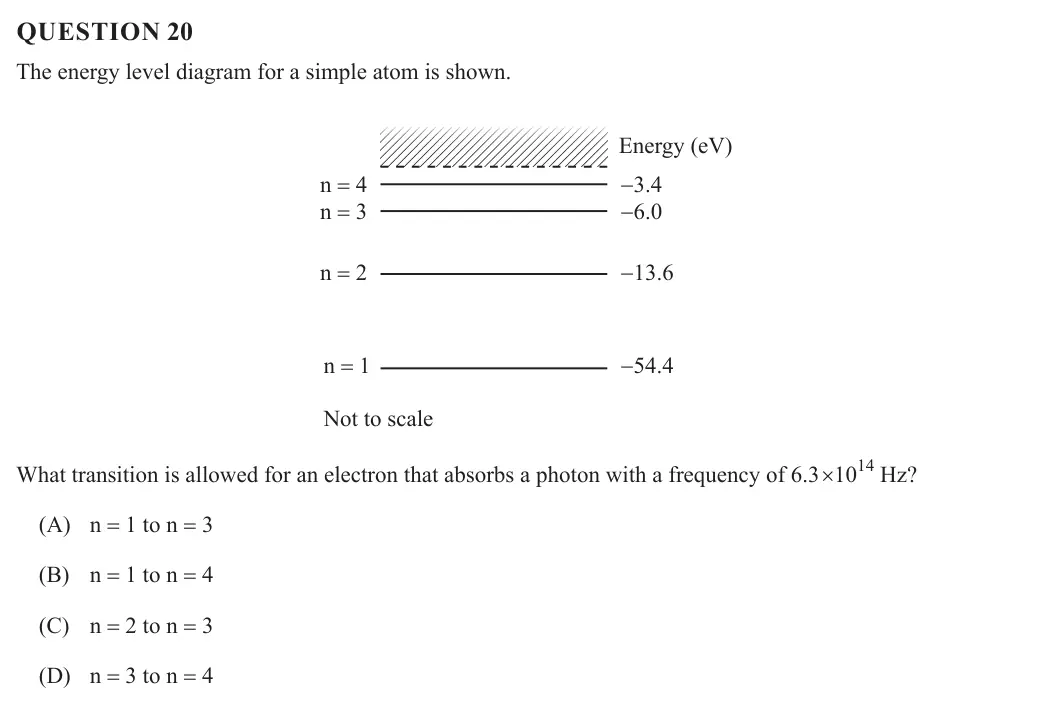
QUESTION 20 The energy level diagram for a simple atom is shown. Energy (eV) -3.4 n = 4 -54.4 n = 1 -6.0 n = 3 -13.6 n = 2 Not to scale What transition is allowed for an electron that absorbs a photon with a frequency of 6.3 ×10¹⁴ Hz? (A) n = 1 to n = 3 (B) n = 1 to n = 4 (C) n = 2 to n = 3 (D) n = 3 to n = 4
0 of 20 answered
Section 2: Short response
Write your answers on paper, showing your working. Then open the official marking guide, compare, and give yourself the marks you earned.

QUESTION 21 (4 marks) Describe how the atomic model proposed by Bohr addresses the limitation of Rutherford’s model.
QUESTION 22 (3 marks) Particles move at a rate of 1.3 × 10⁶ times per second around a circular particle accelerator with a radius of 35 m. Calculate the average speed of the particles. Show your working. Average speed = m s-1 (to two significant figures)

QUESTION 23 (1 mark) List the forces that can be experienced by leptons.
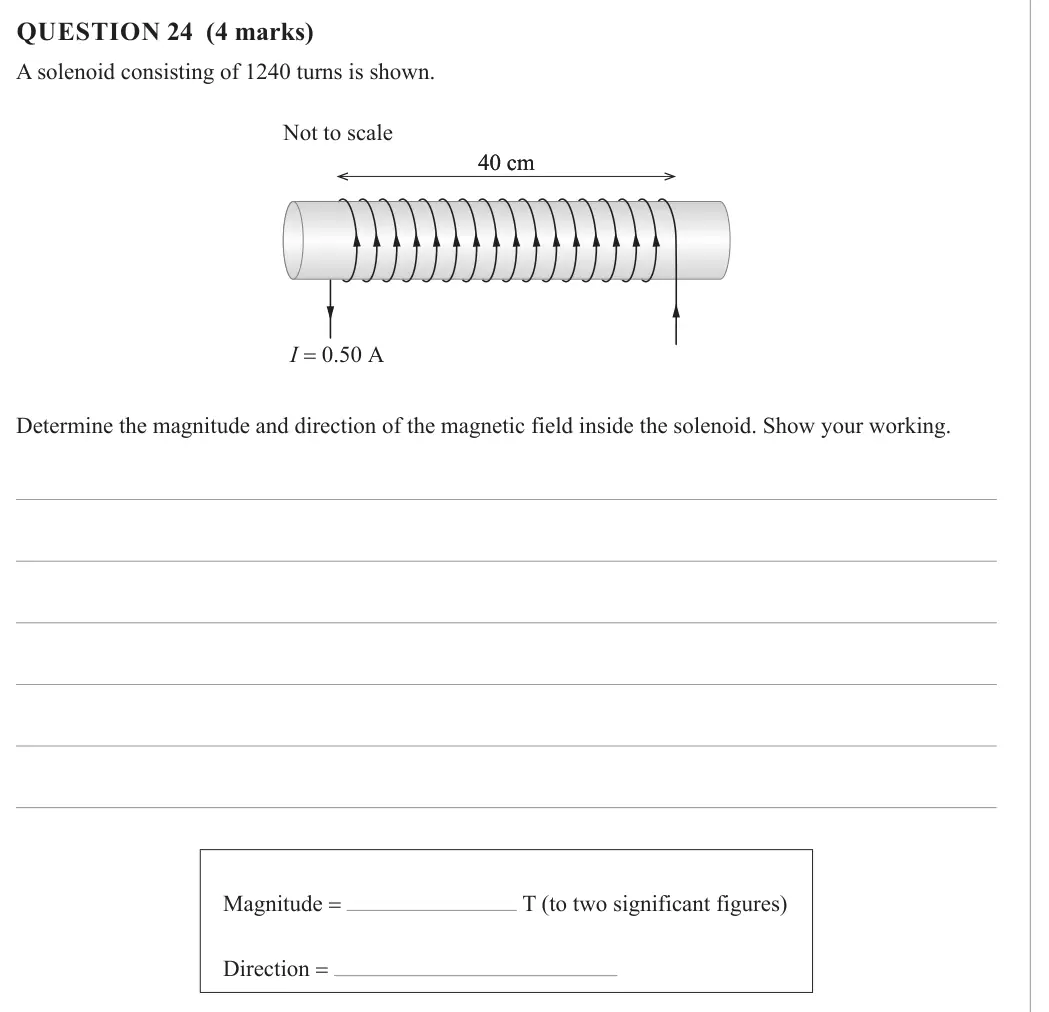
QUESTION 24 (4 marks) A solenoid consisting of 1240 turns is shown. Not to scale I = 0.50 A 40 cm 40 cm Determine the magnitude and direction of the magnetic field inside the solenoid. Show your working. Magnitude = T (to two significant figures) Direction =
QUESTION 25 (3 marks) An observer who is stationary relative to a moving spaceship measures the velocity of the spaceship to be 2.0 × 10⁸ m s-1. Calculate the length of the spaceship if the observer records it as 18 m. Show your working. Length = m (to two significant figures)
QUESTION 26 (4 marks) Calculate the energy (in electron volts) of a photon with a wavelength of 405 nm. Show your working. Energy = eV (to three significant figures)
QUESTION 27 (5 marks) A satellite orbits a planet of mass 6.42 × 10²³ kg at a height of 5000 km from the surface. The planet has a diameter of 6780 km. Determine the speed required for the satellite to maintain its orbit. Show your working. Speed = m s-1 (to two significant figures)
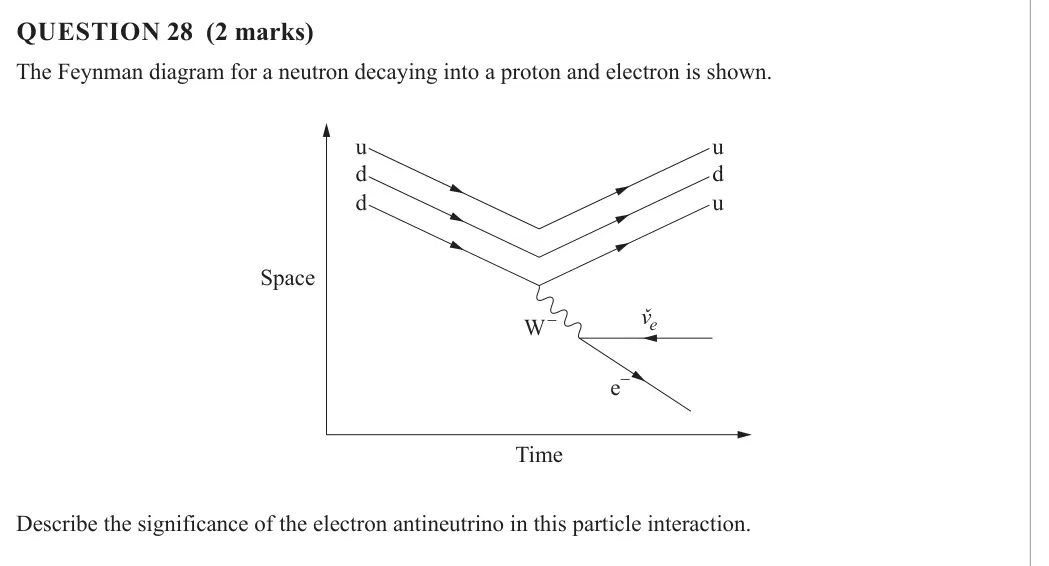
QUESTION 28 (2 marks) The Feynman diagram for a neutron decaying into a proton and electron is shown. Space Time u d d u d u W− e− veˇ Describe the significance of the electron antineutrino in this particle interaction.
Your score
0 / 46
Multiple choice not marked yet. Written: 0 marks from 0 of 8 questions self-marked.