Carregando…
Prova externa de Physics do QCE
2020, Prova 2
9 questões de resposta curta, 37 pontos, 90 minutos. A prova está em inglês, como a original.
90:00
Nada corrigido ainda · prova vale 37Na prova: 10 minutos de leitura (sem escrever) e depois 90 minutos para resolver. Calculadora e livro de fórmulas permitidos. O cronômetro conta o tempo de resolução.
Respostas curtas
Escreva suas respostas no papel, mostrando os cálculos. Depois abra o guia de correção oficial, compare e dê a si mesmo os pontos que ganhou.

QUESTION 1 (1 mark) Explain why an object with mass cannot travel at the speed of light in a vacuum.
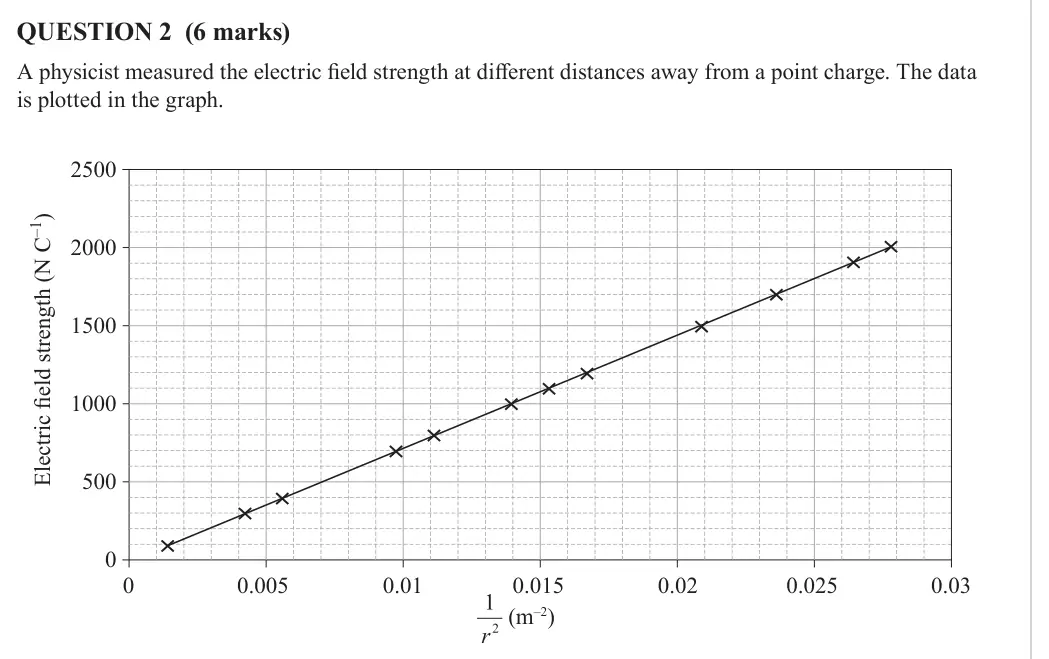
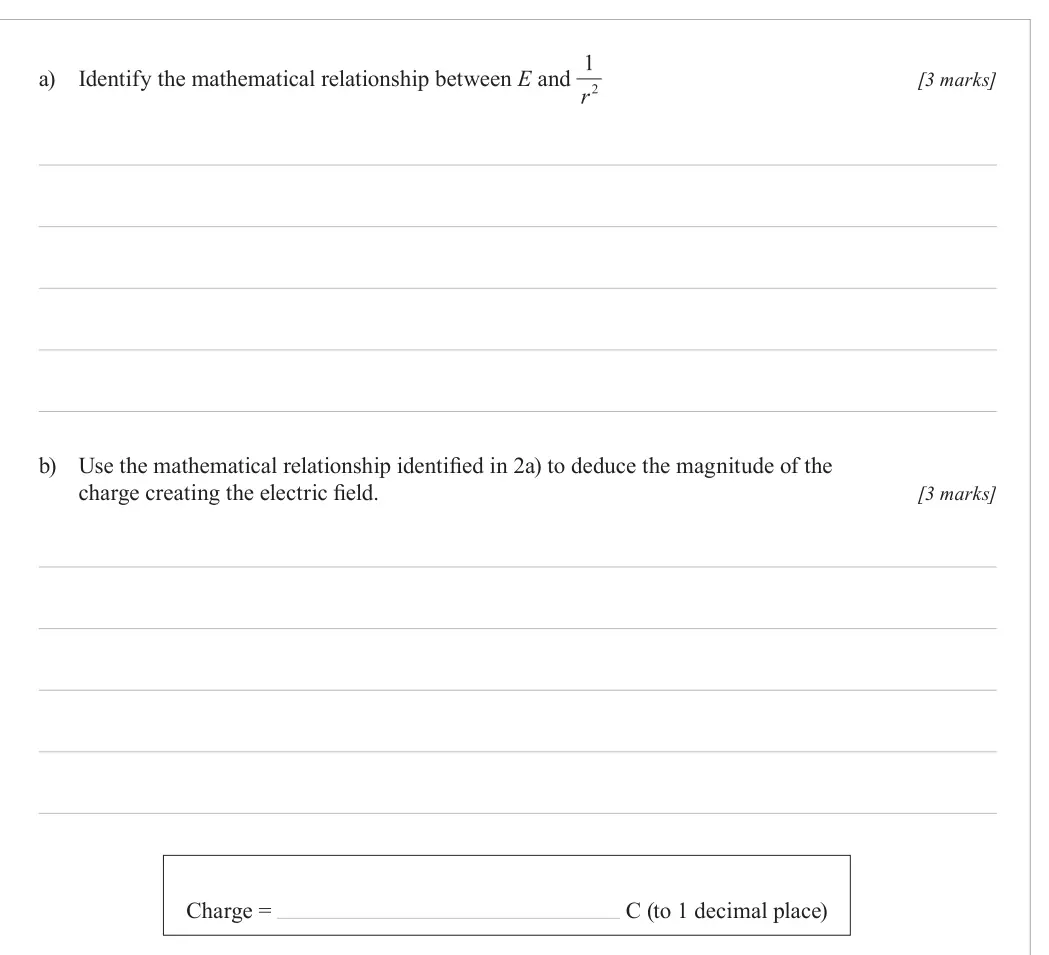
QUESTION 2 (6 marks) A physicist measured the electric field strength at different distances away from a point charge. The data is plotted in the graph. Electric fi eld strength (N C–1) 2500 2000 1500 1000 500 0 0 0.005 0.01 0.015 (m–2) 0.02 0.025 0.03 a) Identify the mathematical relationship between E and [3 marks] b) Use the mathematical relationship identified in 2a) to deduce the magnitude of the charge creating the electric field. [3 marks] Charge = C (to 1 decimal place)
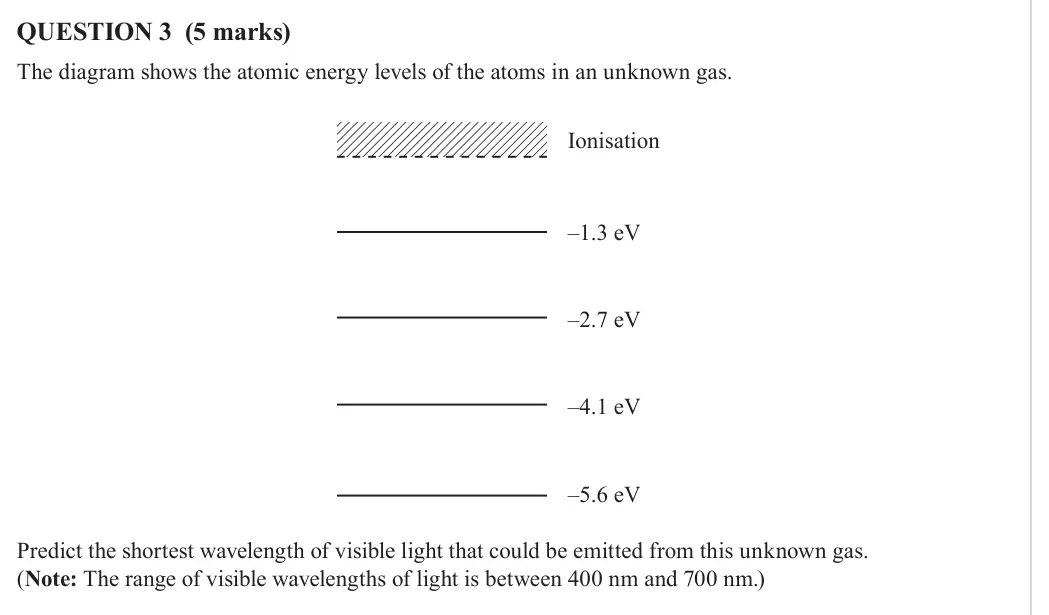
QUESTION 3 (5 marks) The diagram shows the atomic energy levels of the atoms in an unknown gas. Ionisation –5.6 eV –1.3 eV –2.7 eV –4.1 eV Predict the shortest wavelength of visible light that could be emitted from this unknown gas. (Note: The range of visible wavelengths of light is between 400 nm and 700 nm.) Wavelength = nm

QUESTION 4 (5 marks) Describe how experiments on the photoelectric effect provide evidence of the quantised nature of photons.
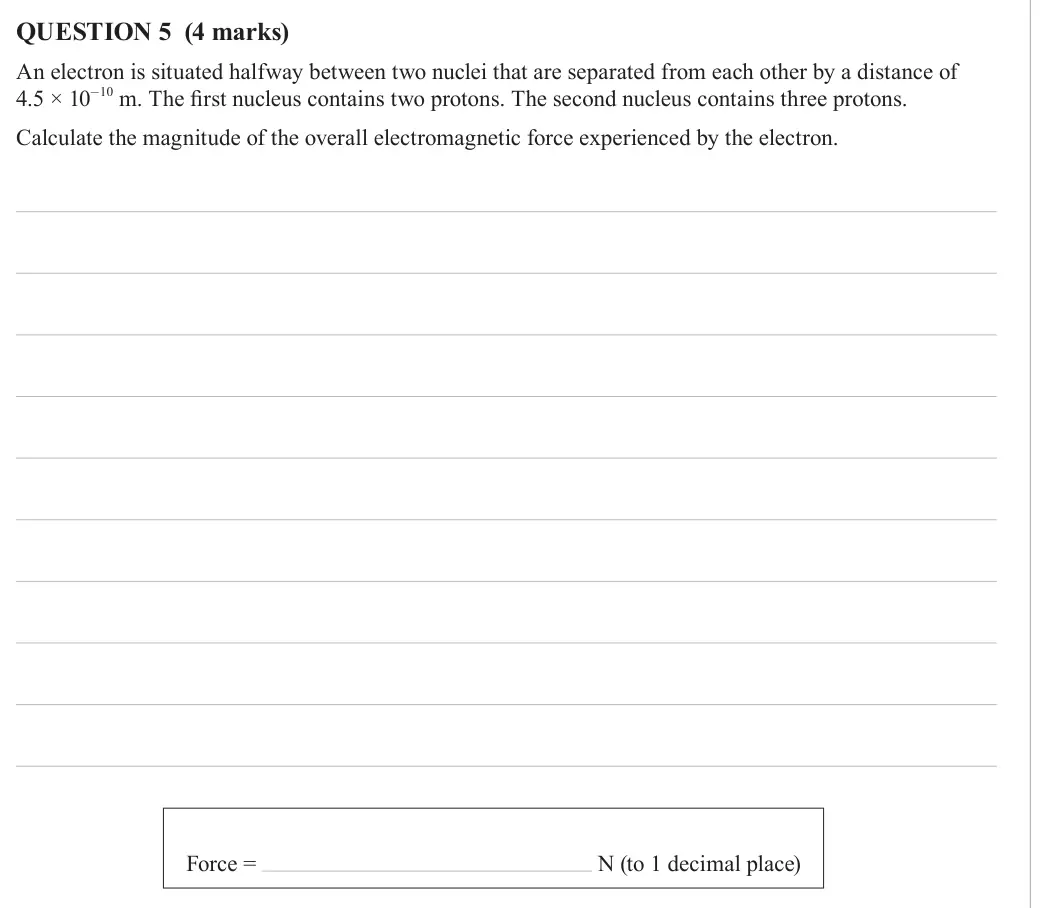
QUESTION 5 (4 marks) An electron is situated halfway between two nuclei that are separated from each other by a distance of 4.5 × 10⁻¹⁰ m. The first nucleus contains two protons. The second nucleus contains three protons. Calculate the magnitude of the overall electromagnetic force experienced by the electron. Force = N (to 1 decimal place)
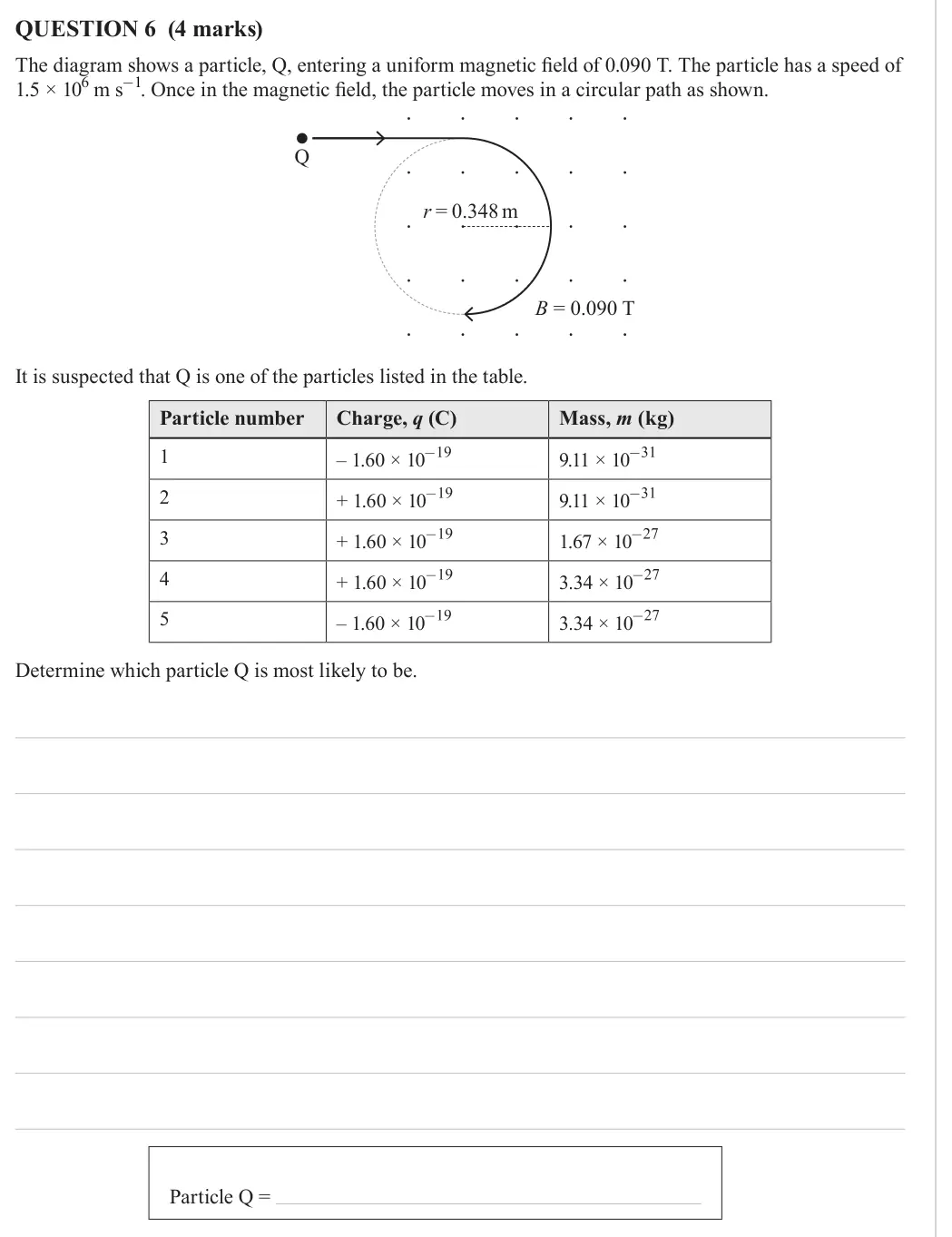
QUESTION 6 (4 marks) The diagram shows a particle, Q, entering a uniform magnetic field of 0.090 T. The particle has a speed of 1.5 × 10 m s-1. Once in the magnetic field, the particle moves in a circular path as shown. Q B = 0.090 T r = 0.348 m It is suspected that Q is one of the particles listed in the table. Particle number Charge, q (C) Mass, m (kg) 1 – 1.60 × 10 9.11 × 10 2 + 1.60 × 10 9.11 × 10 3 + 1.60 × 10 1.67 × 10 4 + 1.60 × 10 3.34 × 10 5 – 1.60 × 10 3.34 × 10 Determine which particle Q is most likely to be. Particle Q =
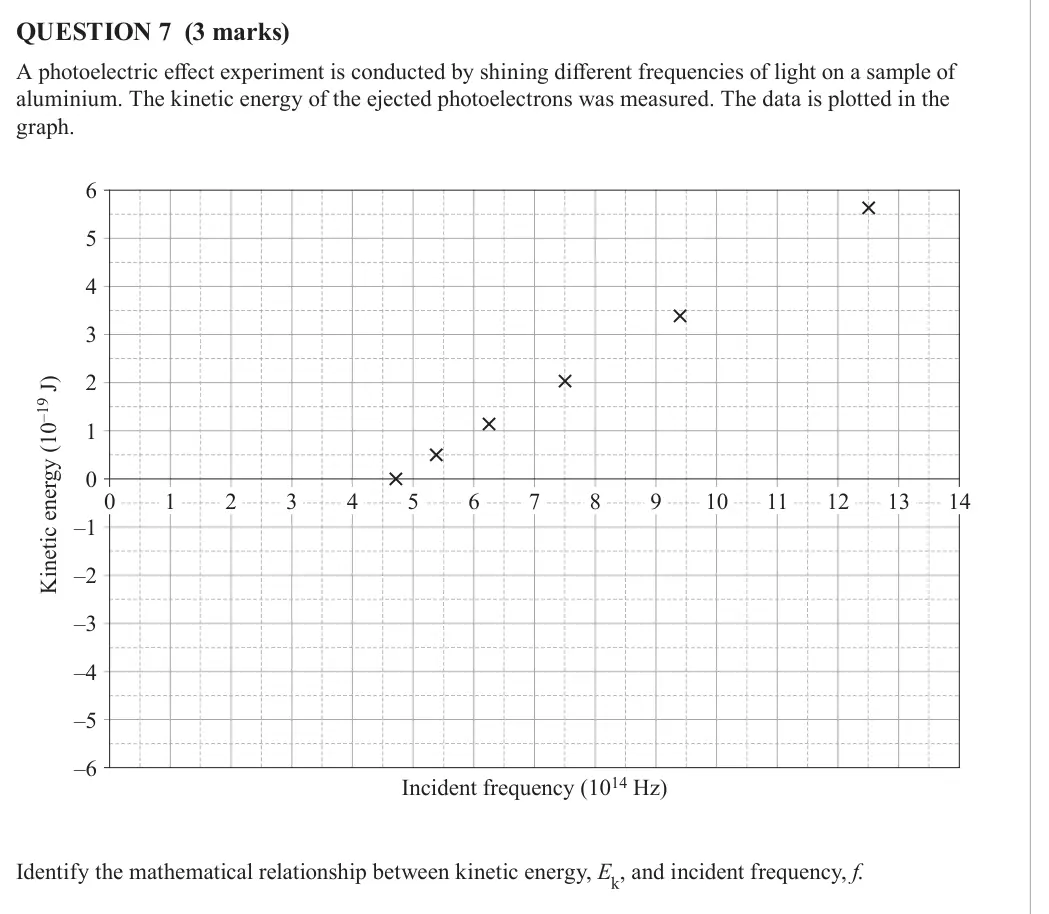
QUESTION 7 (3 marks) A photoelectric effect experiment is conducted by shining different frequencies of light on a sample of aluminium. The kinetic energy of the ejected photoelectrons was measured. The data is plotted in the graph. 6 0 4 –2 2 –4 5 –1 3 –3 1 –5 –6 Incident frequency (1014 Hz) Kinetic energy (10–19 J) 0 4 8 2 6 10 13 1 5 9 12 3 7 11 14 Identify the mathematical relationship between kinetic energy, E , and incident frequency, f.
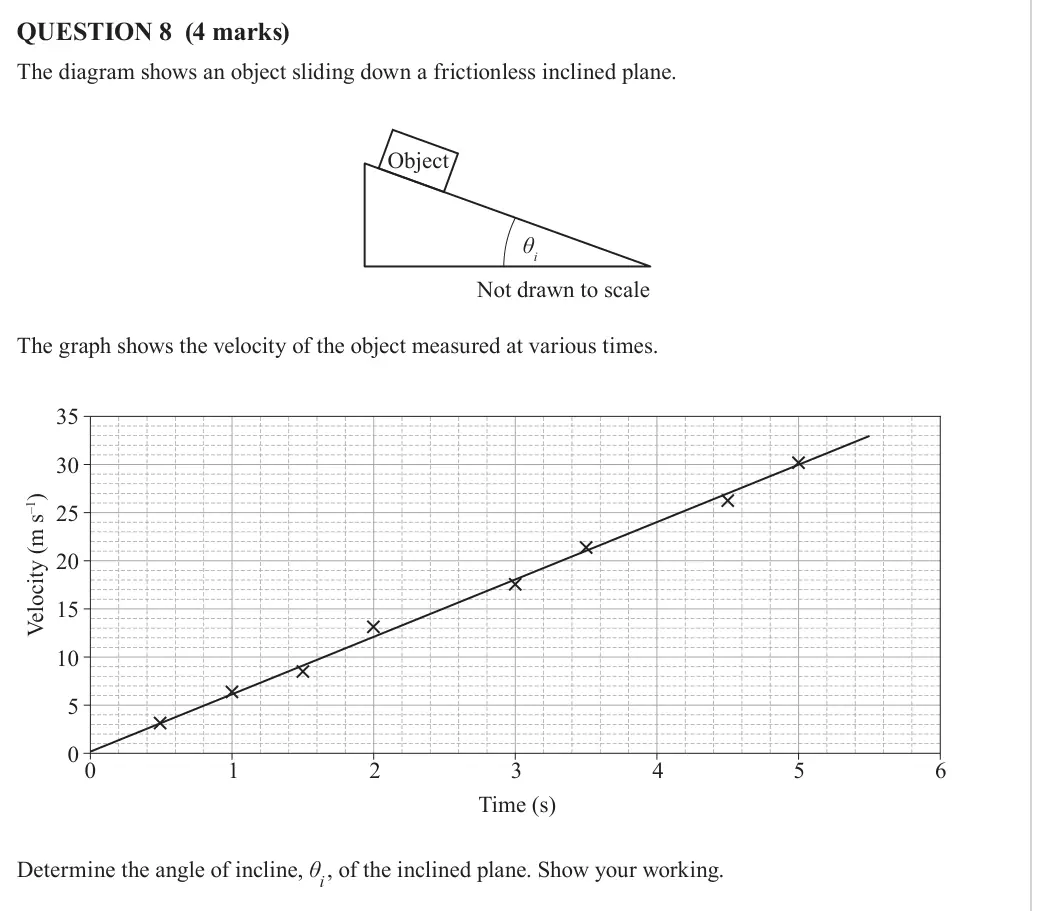

QUESTION 8 (4 marks) The diagram shows an object sliding down a frictionless inclined plane. θi Object Not drawn to scale The graph shows the velocity of the object measured at various times. 35 20 30 10 0 15 25 5 1 3 5 2 4 6 0 Velocity (m s–1) Time (s) Determine the angle of incline, θ , of the inclined plane. Show your working. θi = °
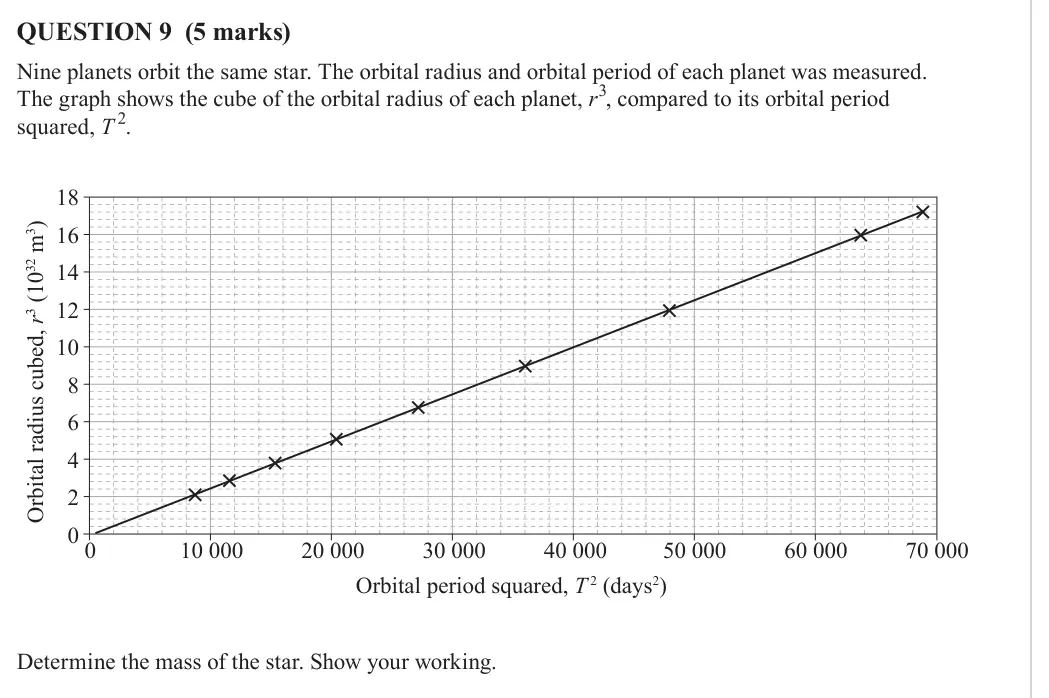
QUESTION 9 (5 marks) Nine planets orbit the same star. The orbital radius and orbital period of each planet was measured. The graph shows the cube of the orbital radius of each planet, r , compared to its orbital period squared, T . 18 12 16 8 4 0 10 14 6 2 10 000 30 000 50 000 20 000 40 000 60 000 0 70 000 Orbital radius cubed, r3 (1032 m3) Orbital period squared, T 2 (days2) Determine the mass of the star. Show your working. Mass = kg (to 1 decimal place)
Sua nota
0 / 37
Escritas: 0 pontos em 0 de 9 questões autocorrigidas.