Loading…
QCE Physics external exam
2021, Paper 1
20 multiple-choice and 6 short-response questions, 43 marks, 90 minutes.
90:00
Nothing marked yet · paper out of 43In the exam room: 10 minutes of perusal (reading, no writing), then 90 minutes of working time. Calculator and formula book allowed. The timer counts the working time.
Section 1: Multiple choice
Choose the best answer for each question, then mark the section.
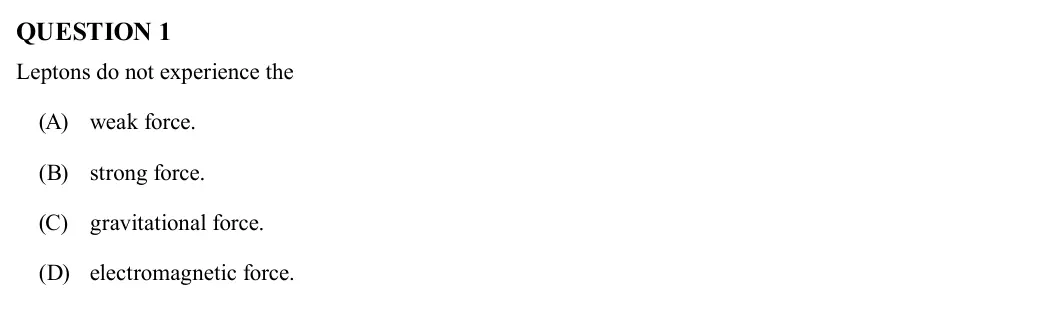
QUESTION 1 Leptons do not experience the (A) weak force. (B) strong force. (C) gravitational force. (D) electromagnetic force.
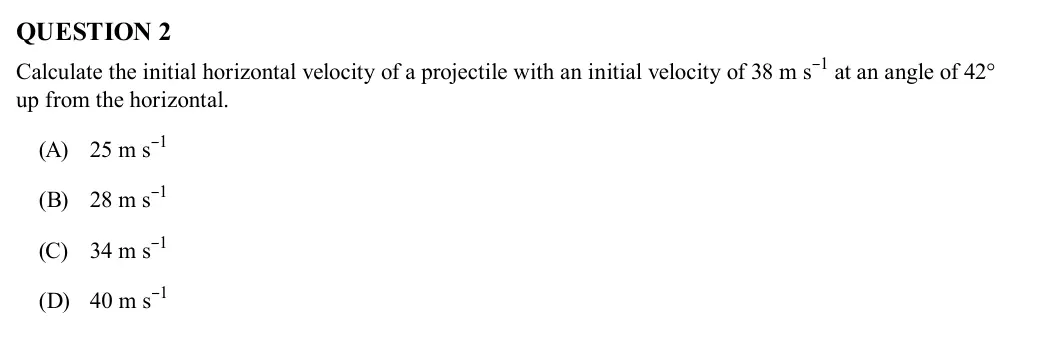
QUESTION 2 Calculate the initial horizontal velocity of a projectile with an initial velocity of 38 m s–1 at an angle of 42° up from the horizontal. (A) 25 m s–1 (B) 28 m s–1 (C) 34 m s–1 (D) 40 m s–1
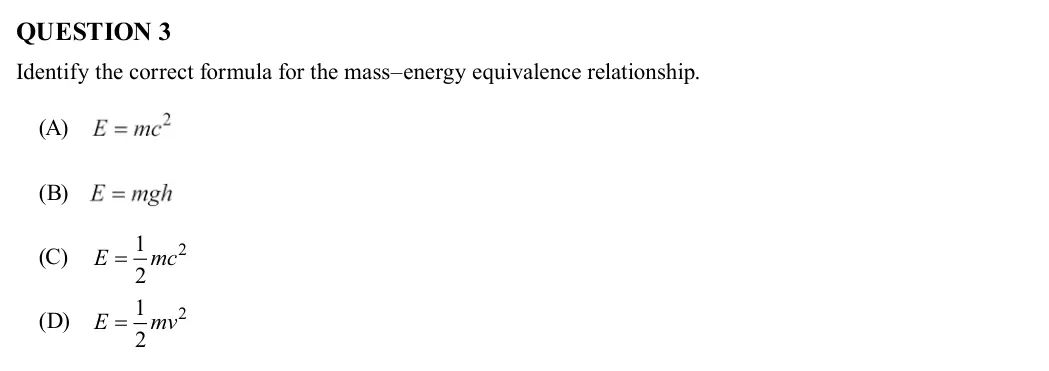
QUESTION 3 Identify the correct formula for the mass–energy equivalence relationship. (A) (B) (C) E mc = 1 2 2 (D) E mv = 1 2 2
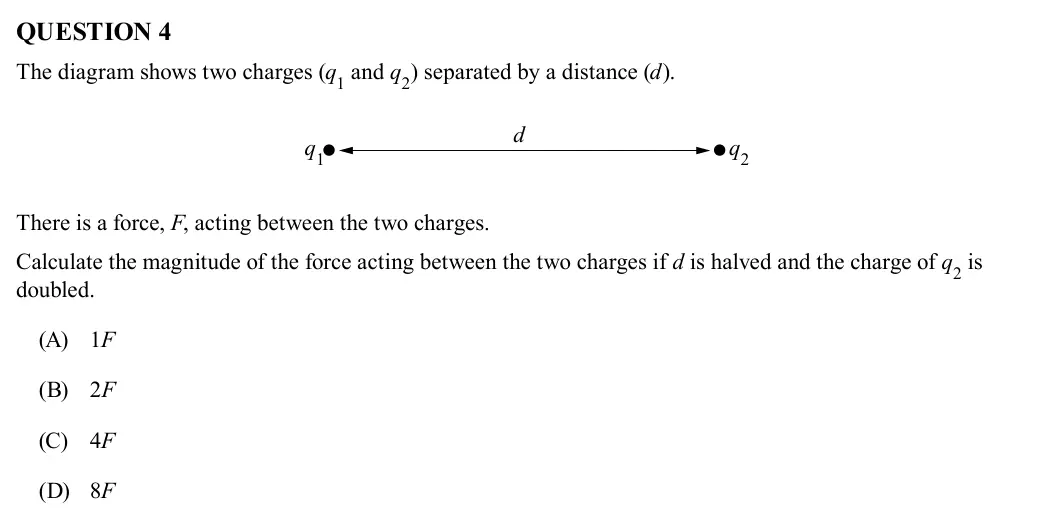
QUESTION 4 The diagram shows two charges (q1 and q2) separated by a distance (d). q1 q2 d There is a force, F, acting between the two charges. Calculate the magnitude of the force acting between the two charges if d is halved and the charge of q2 is doubled. (A) 1F (B) 2F (C) 4F (D) 8F
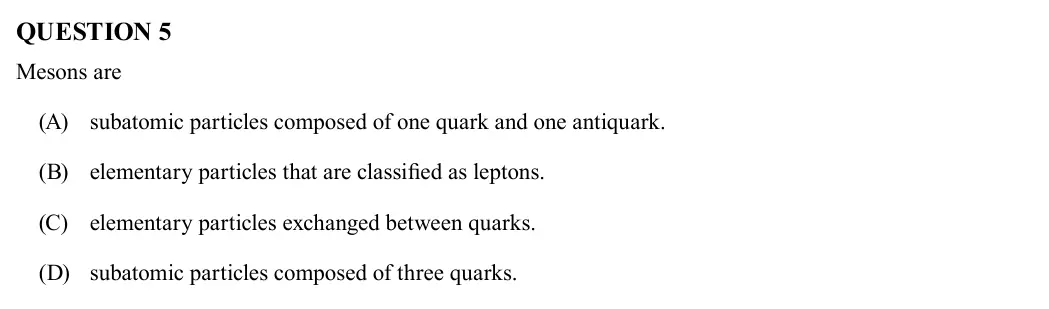
QUESTION 5 Mesons are (A) subatomic particles composed of one quark and one antiquark. (B) elementary particles that are classified as leptons. (C) elementary particles exchanged between quarks. (D) subatomic particles composed of three quarks.
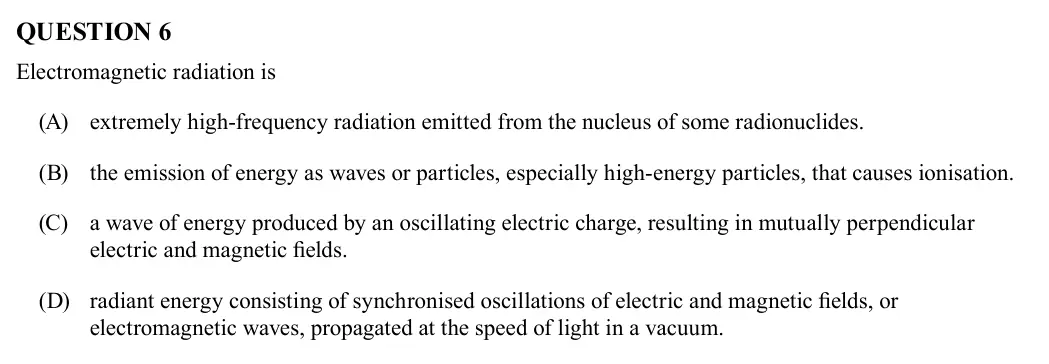
QUESTION 6 Electromagnetic radiation is (A) extremely high-frequency radiation emitted from the nucleus of some radionuclides. (B) the emission of energy as waves or particles, especially high-energy particles, that causes ionisation. (C) a wave of energy produced by an oscillating electric charge, resulting in mutually perpendicular electric and magnetic fields. (D) radiant energy consisting of synchronised oscillations of electric and magnetic fields, or electromagnetic waves, propagated at the speed of light in a vacuum.
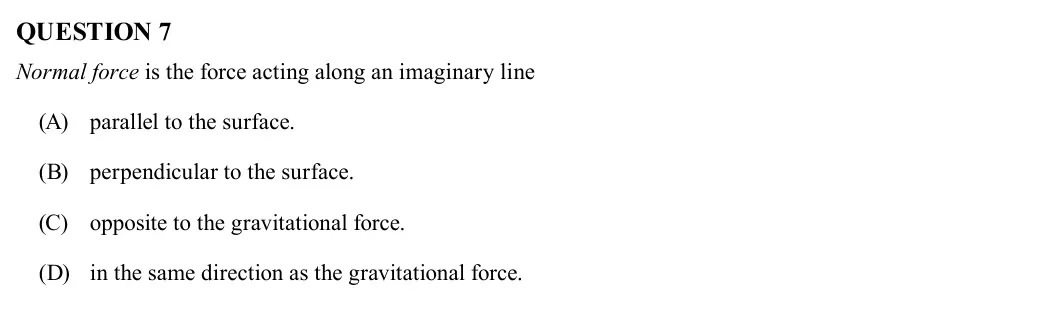
QUESTION 7 Normal force is the force acting along an imaginary line (A) parallel to the surface. (B) perpendicular to the surface. (C) opposite to the gravitational force. (D) in the same direction as the gravitational force.
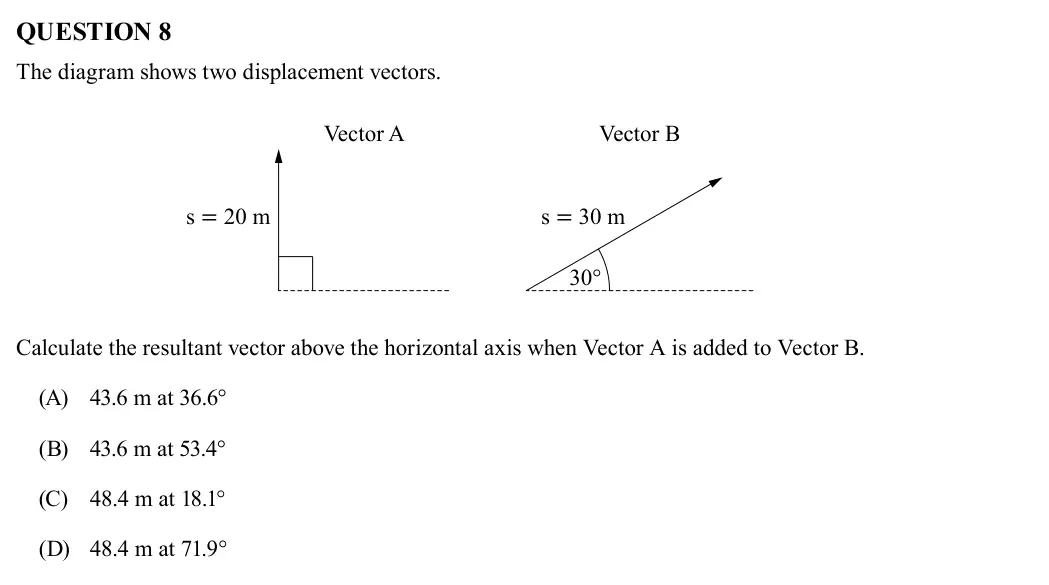
QUESTION 8 The diagram shows two displacement vectors. Vector B Vector A 30° s = 30 m s = 20 m Calculate the resultant vector above the horizontal axis when Vector A is added to Vector B. (A) 43.6 m at 36.6° (B) 43.6 m at 53.4° (C) 48.4 m at 18.1° (D) 48.4 m at 71.9°
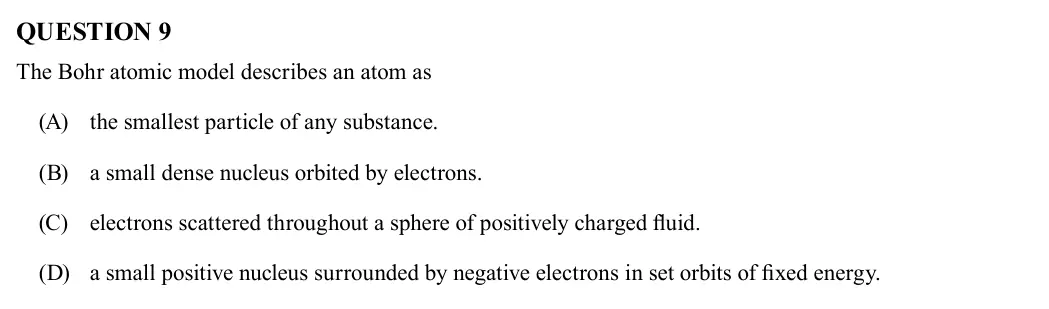
QUESTION 9 The Bohr atomic model describes an atom as (A) the smallest particle of any substance. (B) a small dense nucleus orbited by electrons. (C) electrons scattered throughout a sphere of positively charged fluid. (D) a small positive nucleus surrounded by negative electrons in set orbits of fixed energy.
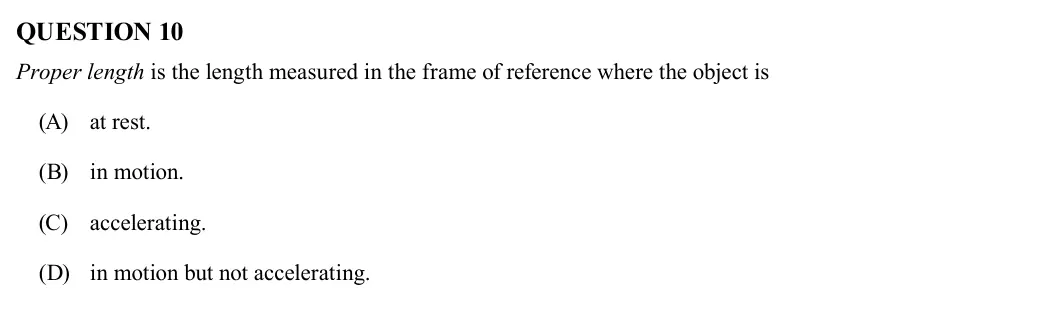
QUESTION 10 Proper length is the length measured in the frame of reference where the object is (A) at rest. (B) in motion. (C) accelerating. (D) in motion but not accelerating.
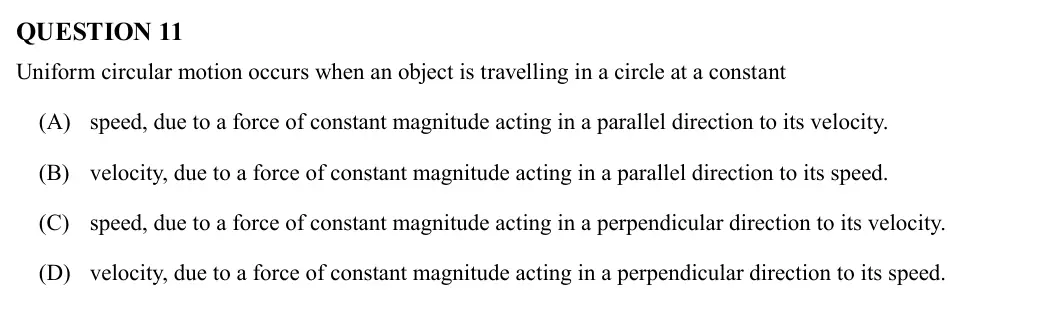
QUESTION 11 Uniform circular motion occurs when an object is travelling in a circle at a constant (A) speed, due to a force of constant magnitude acting in a parallel direction to its velocity. (B) velocity, due to a force of constant magnitude acting in a parallel direction to its speed. (C) speed, due to a force of constant magnitude acting in a perpendicular direction to its velocity. (D) velocity, due to a force of constant magnitude acting in a perpendicular direction to its speed.
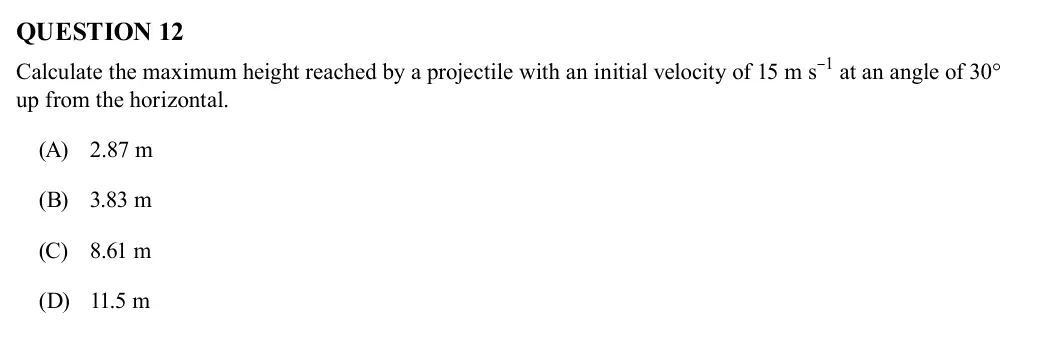
QUESTION 12 Calculate the maximum height reached by a projectile with an initial velocity of 15 m s–1 at an angle of 30° up from the horizontal. (A) 2.87 m (B) 3.83 m (C) 8.61 m (D) 11.5 m
QUESTION 13 Calculate the orbital period of a satellite travelling around the Earth with a radius of 4.00 × 10⁸ m. (A) 3.49 × 10⁻² hours (B) 3.94 × 10² hours (C) 6.99 × 10² hours (D) 1.76 × 10⁹ hours
QUESTION 14 Moving electric charges in a magnetic field experience (A) a decrease in charge. (B) an increase in charge. (C) a force parallel to the direction of the magnetic field. (D) a force perpendicular to the direction of the magnetic field.
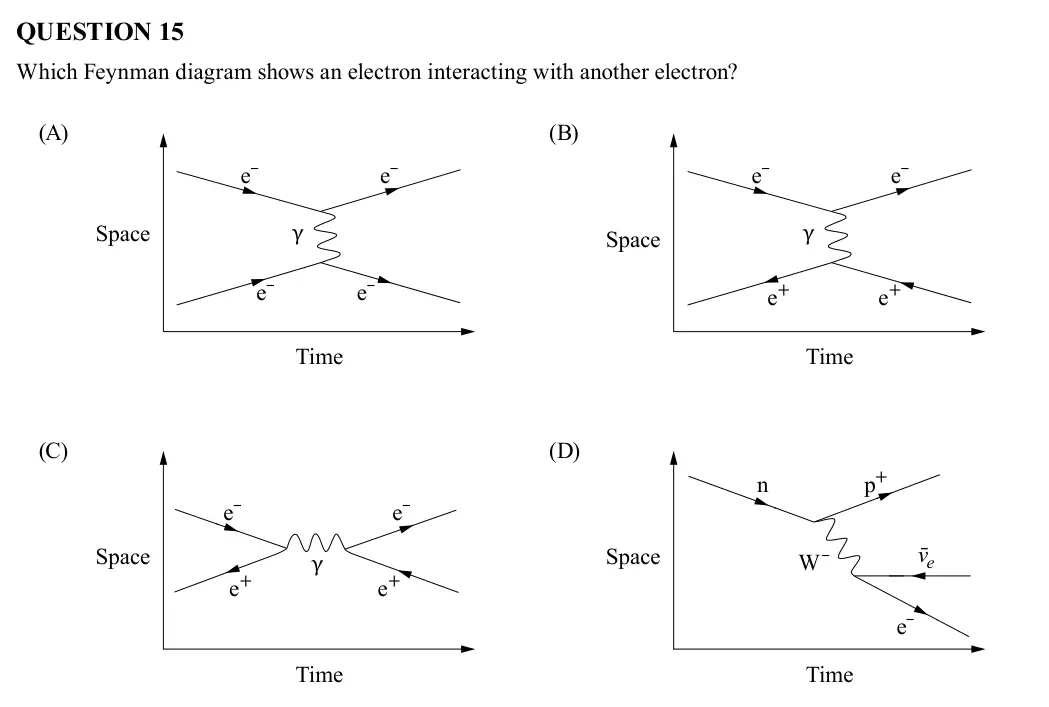
QUESTION 15 Which Feynman diagram shows an electron interacting with another electron? (A) Space Time γ e– e– e– e– (B) Space Time γ e– e– e+ e+ (C) Space Time γ e– e– e+ e+ (D) Space Time p+ e– W– n ve
QUESTION 16 The weight of a 5 kg object on Earth is (A) 0.49 N (B) 0.51 N (C) 49 N (D) 51 N
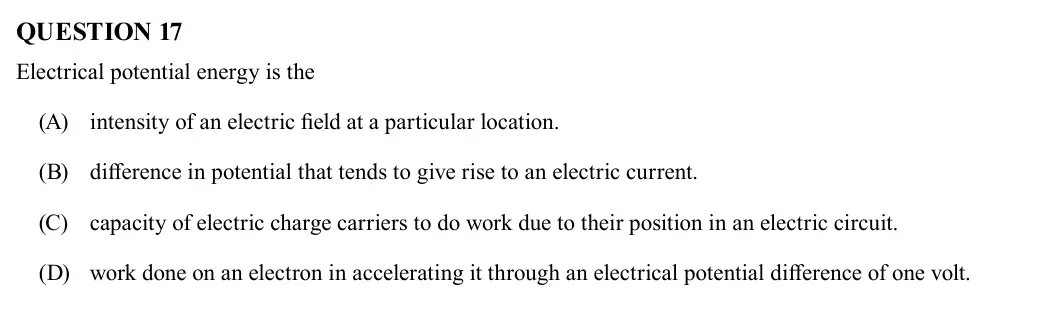
QUESTION 17 Electrical potential energy is the (A) intensity of an electric field at a particular location. (B) difference in potential that tends to give rise to an electric current. (C) capacity of electric charge carriers to do work due to their position in an electric circuit. (D) work done on an electron in accelerating it through an electrical potential difference of one volt.
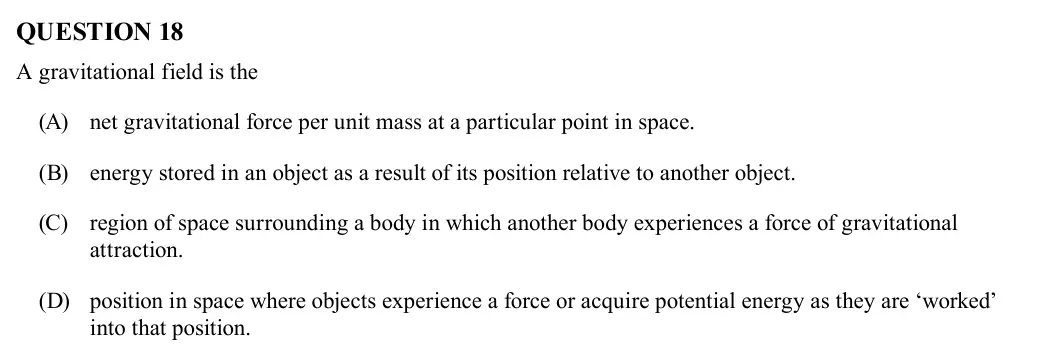
QUESTION 18 A gravitational field is the (A) net gravitational force per unit mass at a particular point in space. (B) energy stored in an object as a result of its position relative to another object. (C) region of space surrounding a body in which another body experiences a force of gravitational attraction. (D) position in space where objects experience a force or acquire potential energy as they are ‘worked’ into that position.
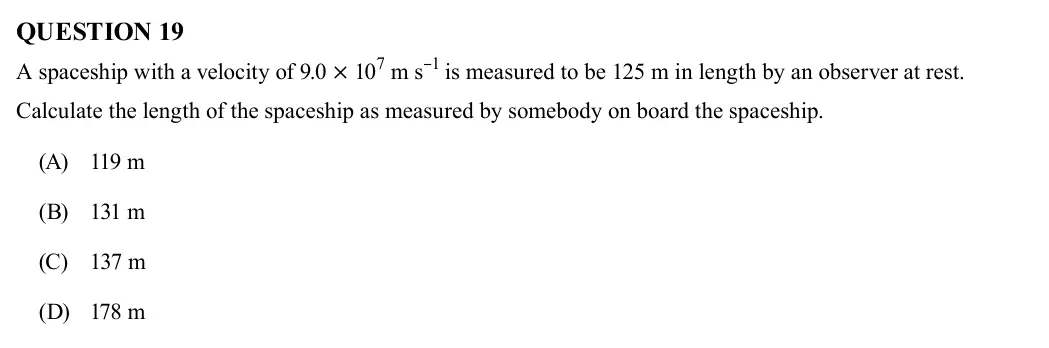
QUESTION 19 A spaceship with a velocity of 9.0 × 10⁷ m s–1 is measured to be 125 m in length by an observer at rest. Calculate the length of the spaceship as measured by somebody on board the spaceship. (A) 119 m (B) 131 m (C) 137 m (D) 178 m
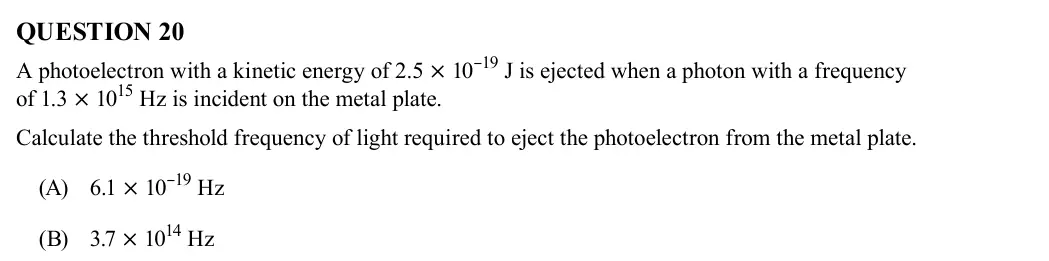
QUESTION 20 A photoelectron with a kinetic energy of 2.5 × 10⁻¹⁹ J is ejected when a photon with a frequency of 1.3 × 10¹⁵ Hz is incident on the metal plate. Calculate the threshold frequency of light required to eject the photoelectron from the metal plate. (A) 6.1 × 10⁻¹⁹ Hz (B) 3.7 × 10¹⁴ Hz
0 of 20 answered
Section 2: Short response
Write your answers on paper, showing your working. Then open the official marking guide, compare, and give yourself the marks you earned.

QUESTION 21 (3 marks) Explain how transformers work in terms of Faraday’s law and electromagnetic induction.
QUESTION 22 (3 marks) A planet is orbiting a 3.38 × 1031 kg star. The radius of the orbit is 4.23 × 10⁸ km. Calculate the average speed of the planet. Average speed = m s–1 (to the nearest whole number)
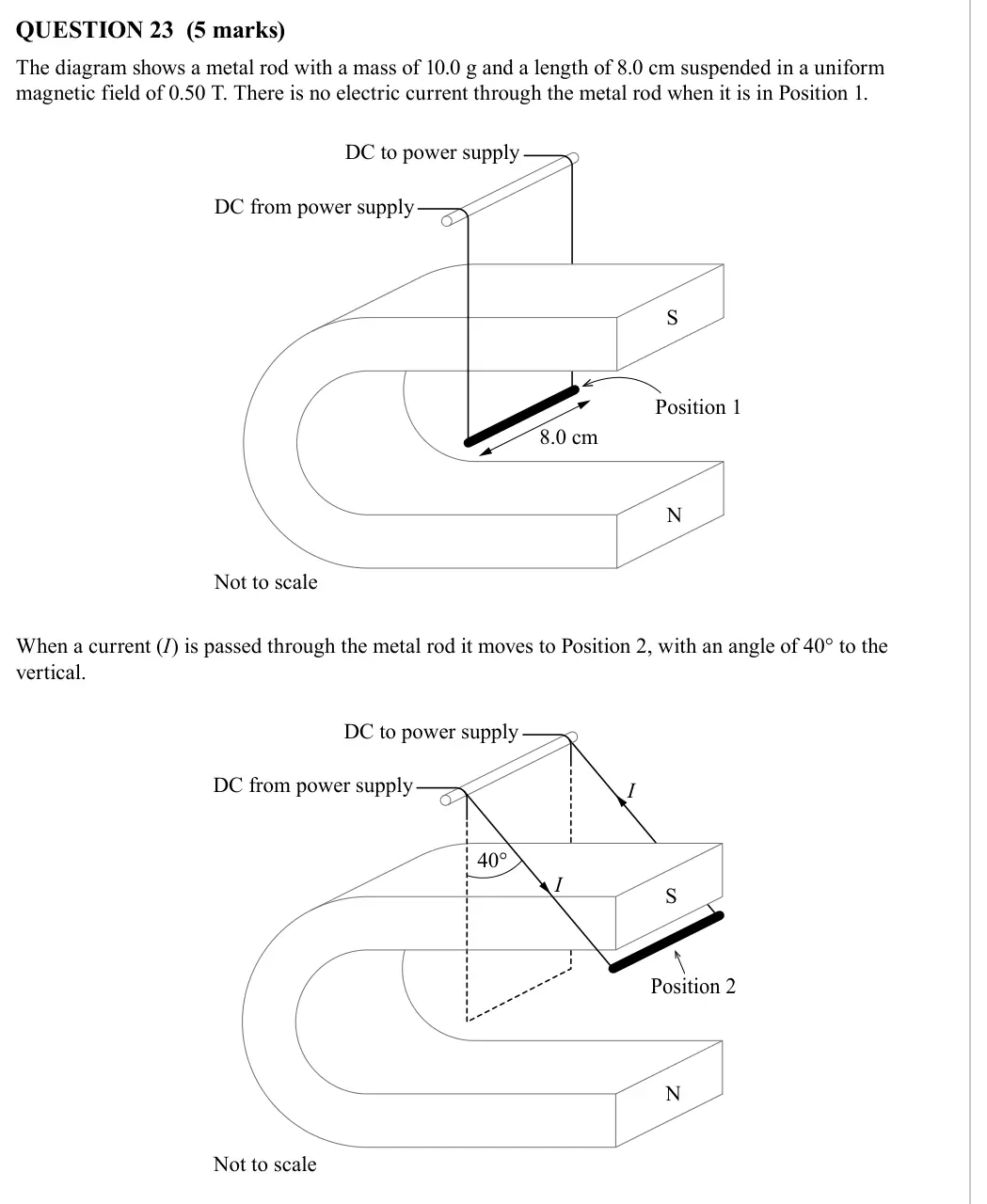
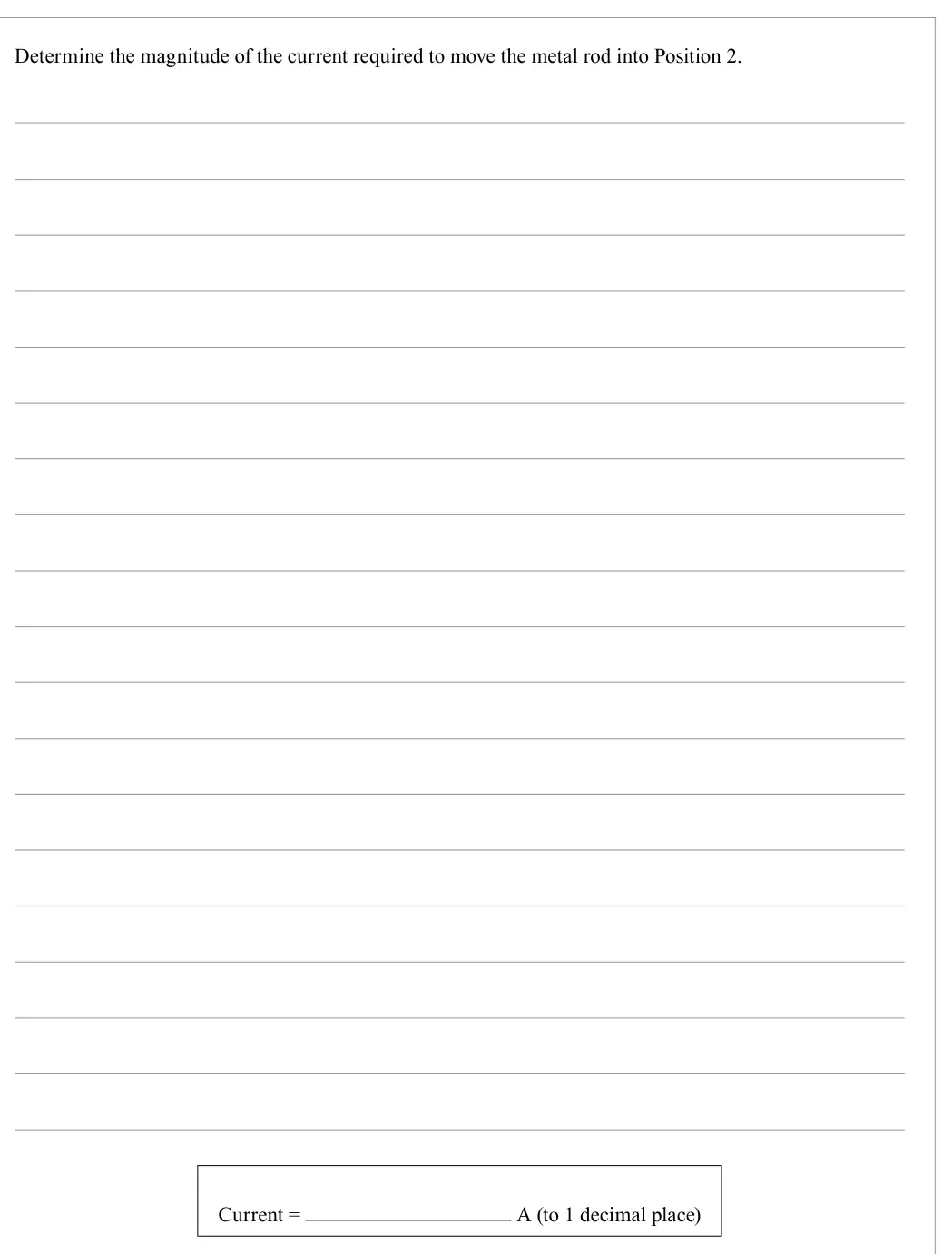
QUESTION 23 (5 marks) The diagram shows a metal rod with a mass of 10.0 g and a length of 8.0 cm suspended in a uniform magnetic field of 0.50 T. There is no electric current through the metal rod when it is in Position 1. DC to power supply DC from power supply Not to scale Position 1 S N 8.0 cm When a current (I) is passed through the metal rod it moves to Position 2, with an angle of 40° to the vertical. DC to power supply DC from power supply 40° Position 2 S N I I Not to scale Determine the magnitude of the current required to move the metal rod into Position 2. Current = A (to 1 decimal place)
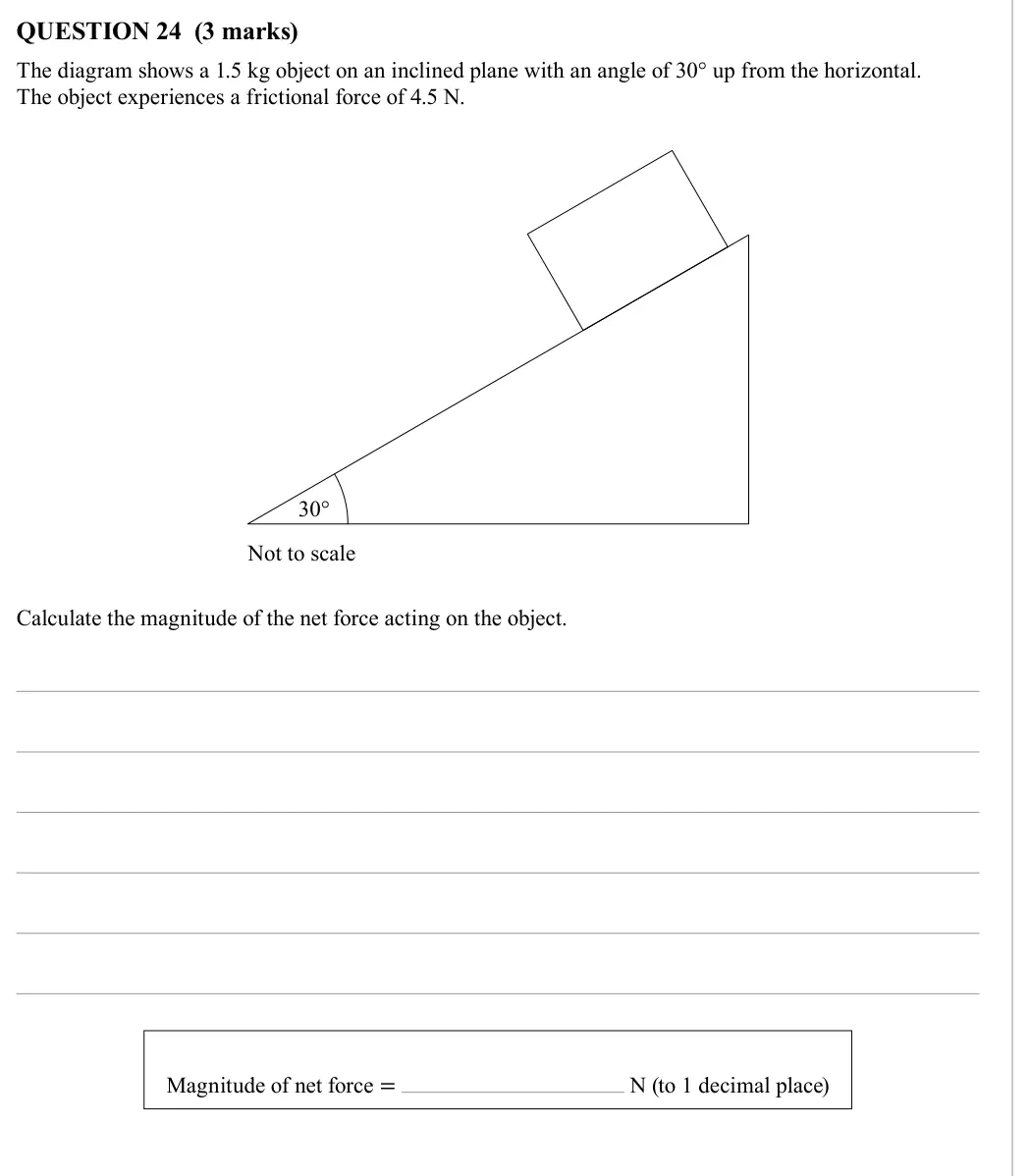
QUESTION 24 (3 marks) The diagram shows a 1.5 kg object on an inclined plane with an angle of 30° up from the horizontal. The object experiences a frictional force of 4.5 N. 30° Not to scale Calculate the magnitude of the net force acting on the object. Magnitude of net force = N (to 1 decimal place)
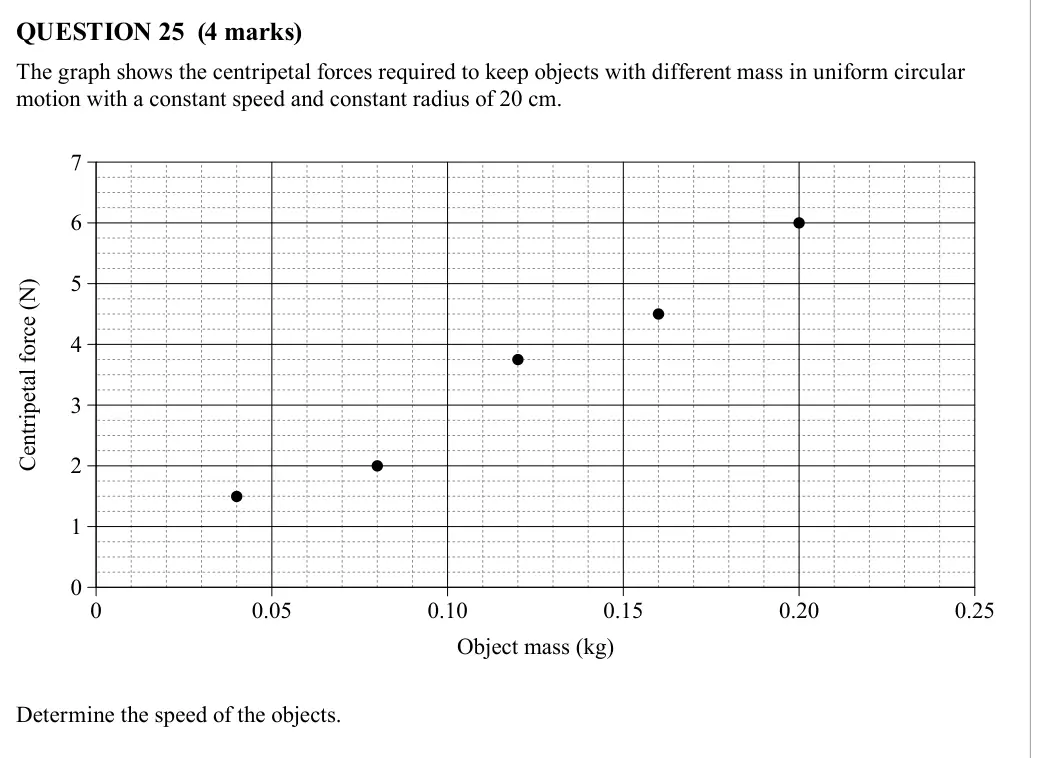
QUESTION 25 (4 marks) The graph shows the centripetal forces required to keep objects with different mass in uniform circular motion with a constant speed and constant radius of 20 cm. Centripetal force (N) Object mass (kg) 0 0 0.05 0.10 0.15 0.20 0.25 1 2 3 4 5 6 7 Determine the speed of the objects.
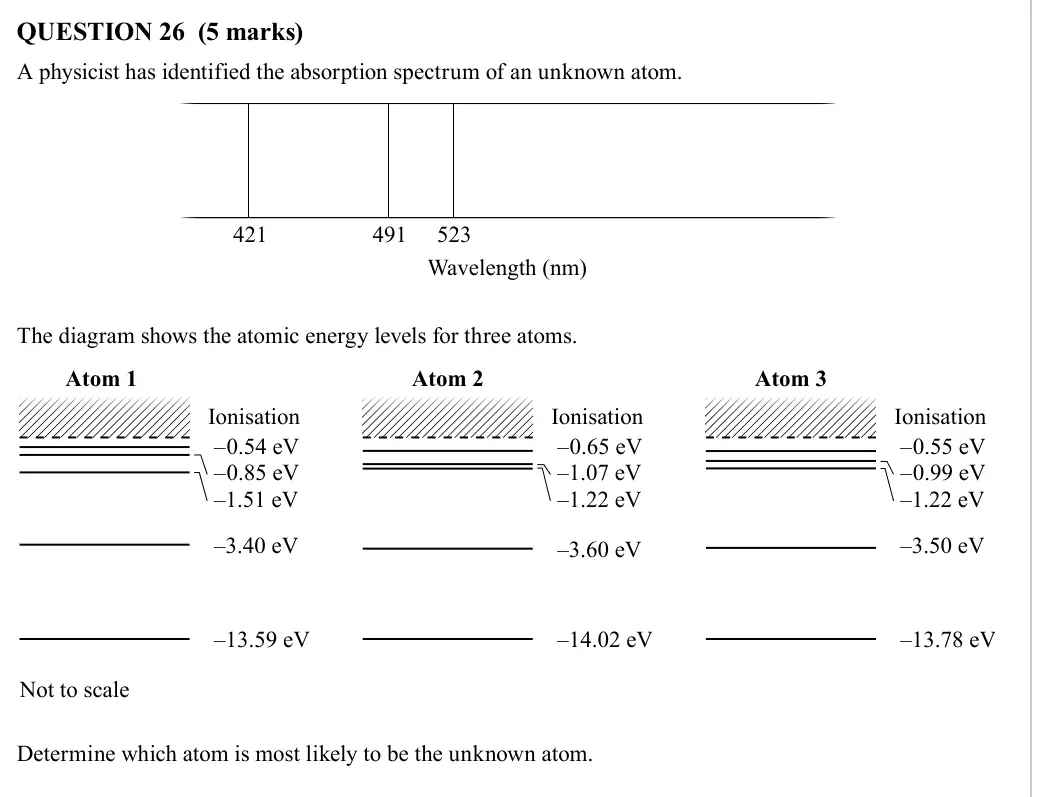
QUESTION 26 (5 marks) A physicist has identified the absorption spectrum of an unknown atom. Wavelength (nm) 491 523 421 The diagram shows the atomic energy levels for three atoms. Ionisation –0.85 eV –0.54 eV –13.59 eV –1.51 eV –3.40 eV Ionisation –1.07 eV –0.65 eV –14.02 eV –1.22 eV –3.60 eV Ionisation –0.99 eV –0.55 eV –13.78 eV –1.22 eV –3.50 eV Atom 1 Atom 2 Atom 3 Not to scale Determine which atom is most likely to be the unknown atom.
Your score
0 / 43
Multiple choice not marked yet. Written: 0 marks from 0 of 6 questions self-marked.