Carregando…
Prova externa de Physics do QCE
2021, Prova 2
9 questões de resposta curta, 32 pontos, 90 minutos. A prova está em inglês, como a original.
90:00
Nada corrigido ainda · prova vale 32Na prova: 10 minutos de leitura (sem escrever) e depois 90 minutos para resolver. Calculadora e livro de fórmulas permitidos. O cronômetro conta o tempo de resolução.
Respostas curtas
Escreva suas respostas no papel, mostrando os cálculos. Depois abra o guia de correção oficial, compare e dê a si mesmo os pontos que ganhou.
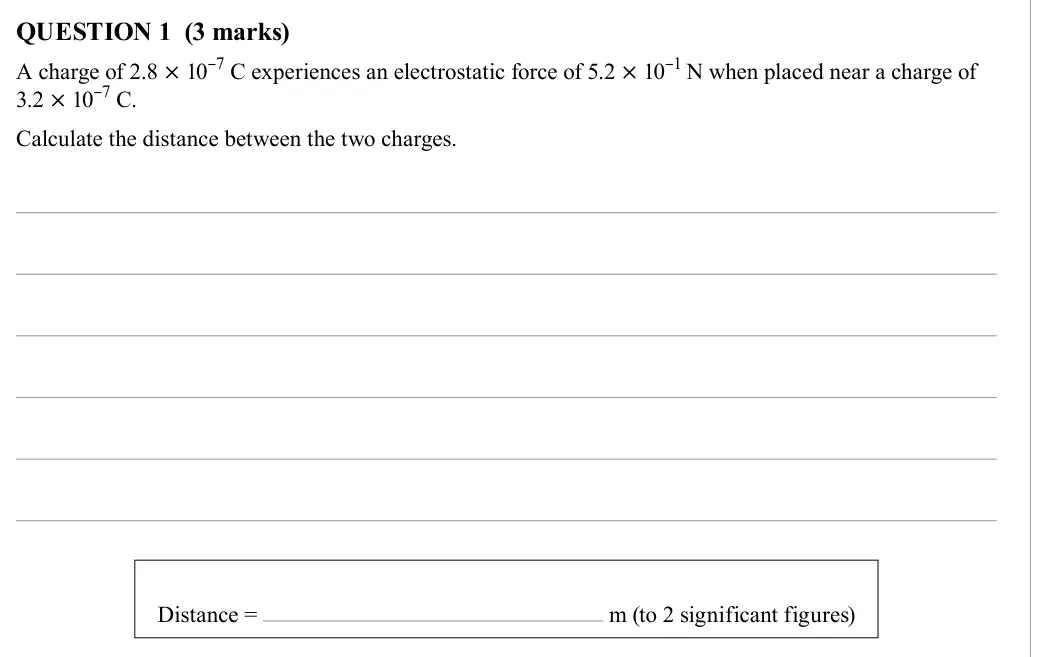
QUESTION 1 (3 marks) A charge of 2.8 × 10⁻⁷ C experiences an electrostatic force of 5.2 × 10⁻¹ N when placed near a charge of 3.2 × 10⁻⁷ C. Calculate the distance between the two charges. Distance = m (to 2 significant figures)
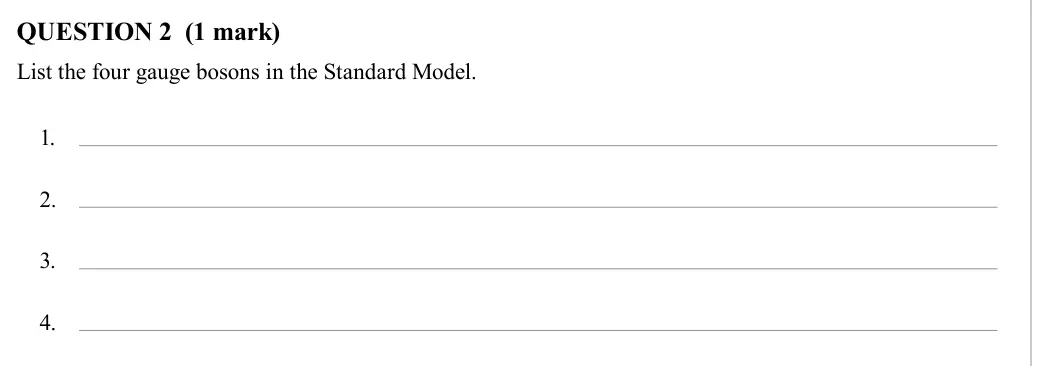
QUESTION 2 (1 mark) List the four gauge bosons in the Standard Model. 1. 2. 3. 4.

QUESTION 3 (3 marks) An object undergoes uniform circular motion in a path with a radius of r. Determine the effect on the radius if the mass of the object is doubled, but the centripetal force and velocity remain unchanged.
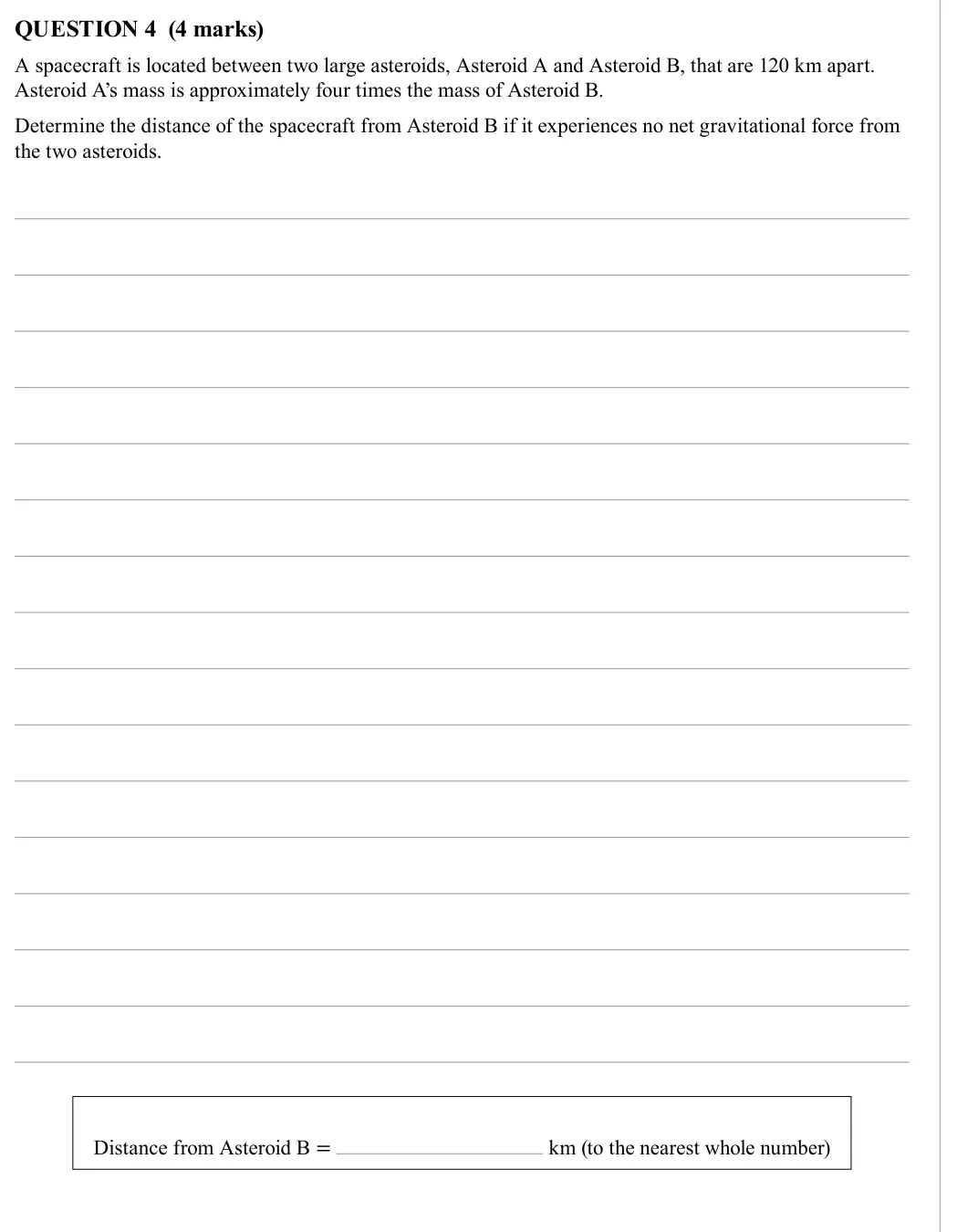
QUESTION 4 (4 marks) A spacecraft is located between two large asteroids, Asteroid A and Asteroid B, that are 120 km apart. Asteroid A’s mass is approximately four times the mass of Asteroid B. Determine the distance of the spacecraft from Asteroid B if it experiences no net gravitational force from the two asteroids. Distance from Asteroid B = km (to the nearest whole number)
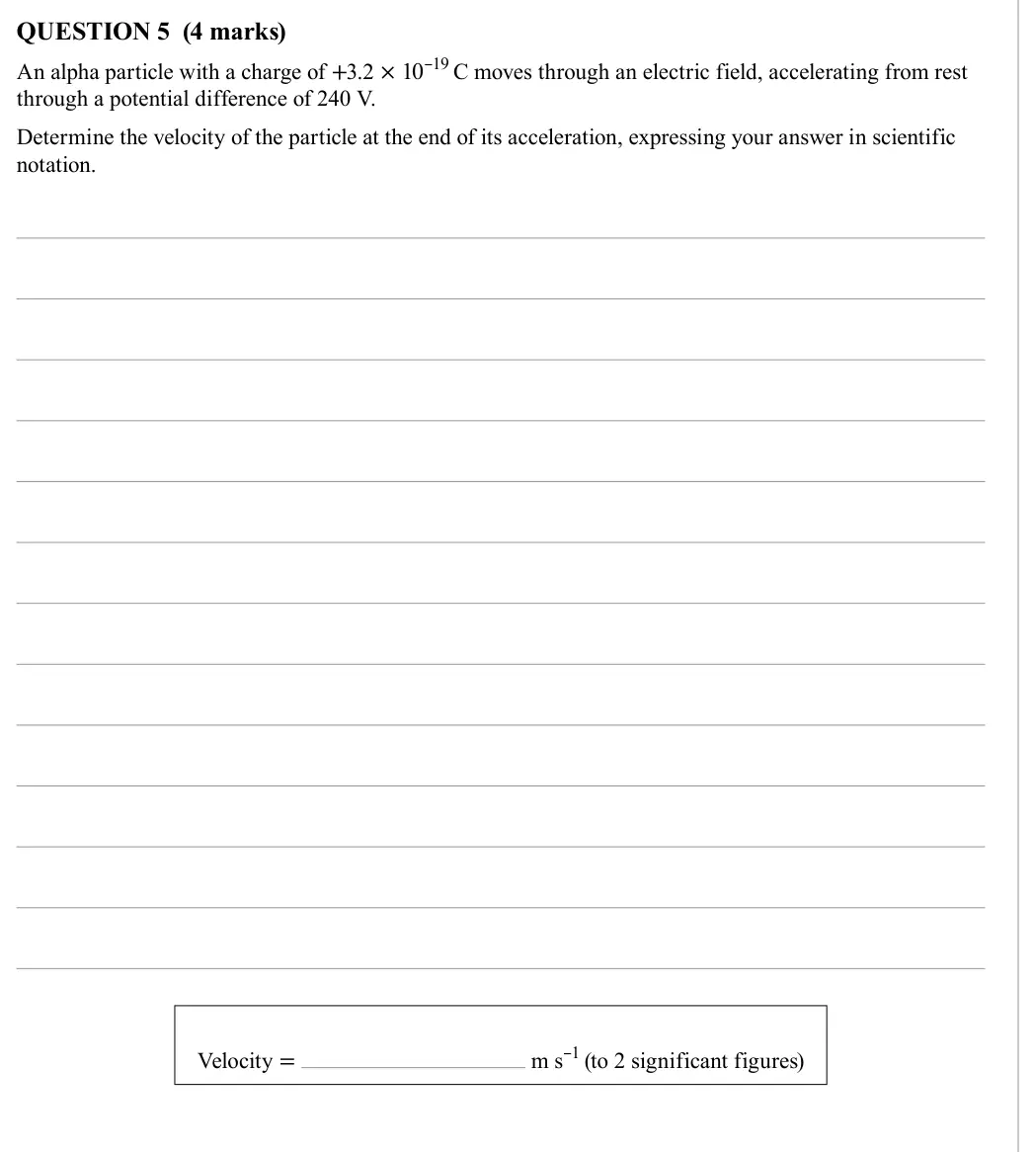
QUESTION 5 (4 marks) An alpha particle with a charge of +3.2 × 10⁻¹⁹ C moves through an electric field, accelerating from rest through a potential difference of 240 V. Determine the velocity of the particle at the end of its acceleration, expressing your answer in scientific notation. Velocity = m s–1 (to 2 significant figures)
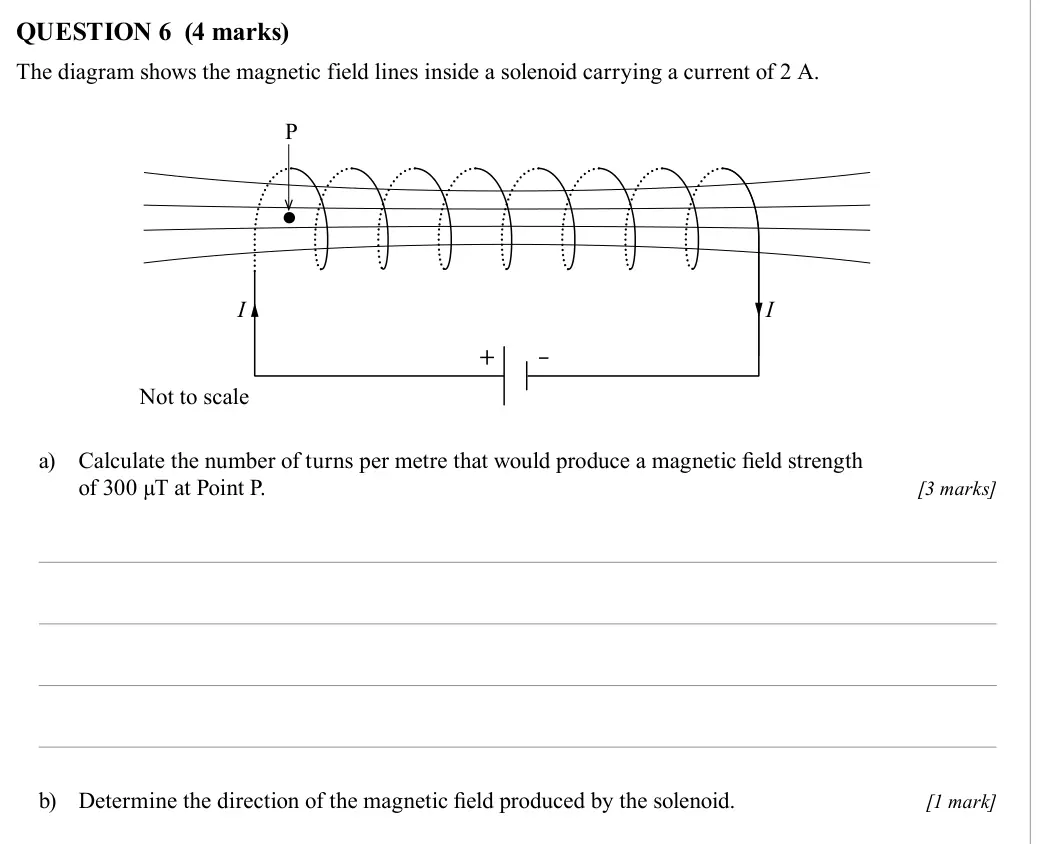
QUESTION 6 (4 marks) The diagram shows the magnetic field lines inside a solenoid carrying a current of 2 A. P I I + – Not to scale a) Calculate the number of turns per metre that would produce a magnetic field strength of 300 µT at Point P. [3 marks] b) Determine the direction of the magnetic field produced by the solenoid. [1 mark]
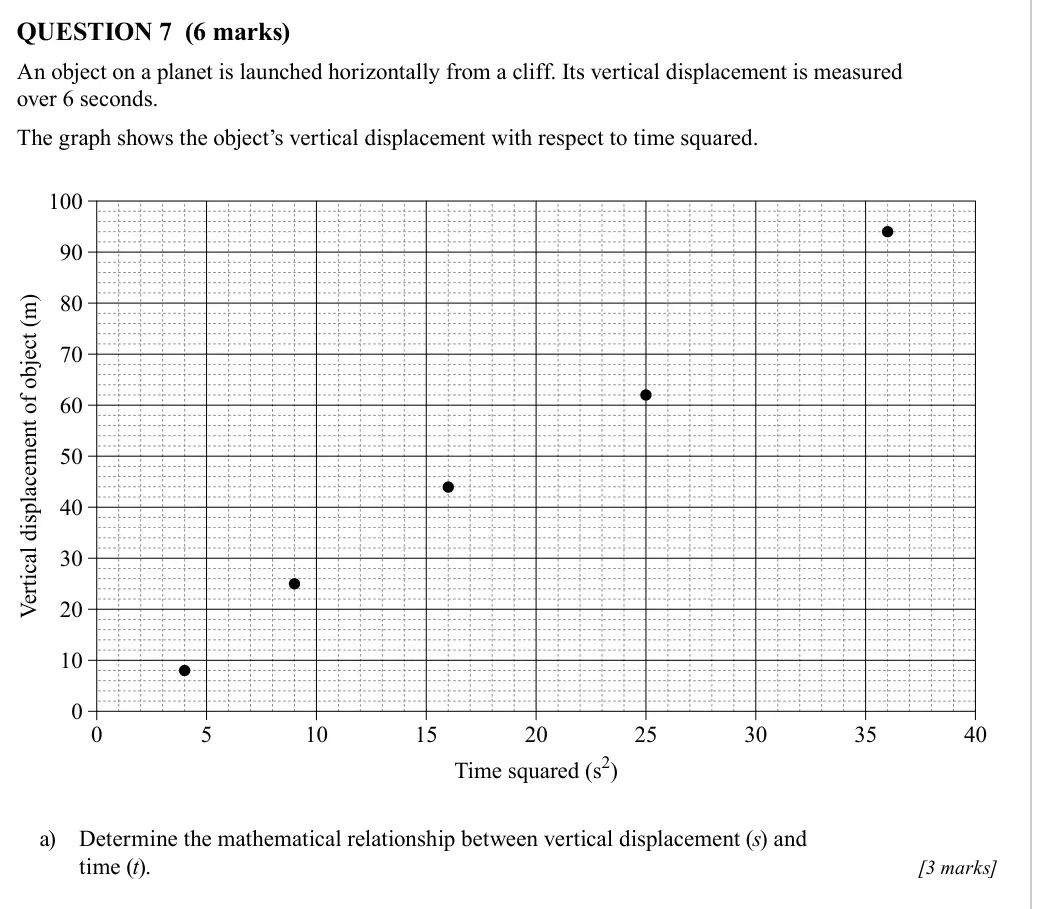
QUESTION 7 (6 marks) An object on a planet is launched horizontally from a cliff. Its vertical displacement is measured over 6 seconds. The graph shows the object’s vertical displacement with respect to time squared. Vertical displacement of object (m) Time squared (s2) 0 0 5 10 15 25 20 30 35 40 10 20 30 50 70 90 40 100 60 80 a) Determine the mathematical relationship between vertical displacement (s) and time (t). [3 marks] b) Calculate the acceleration due to gravity on the planet. [3 marks] Acceleration = m s–2 (to 2 significant figures)
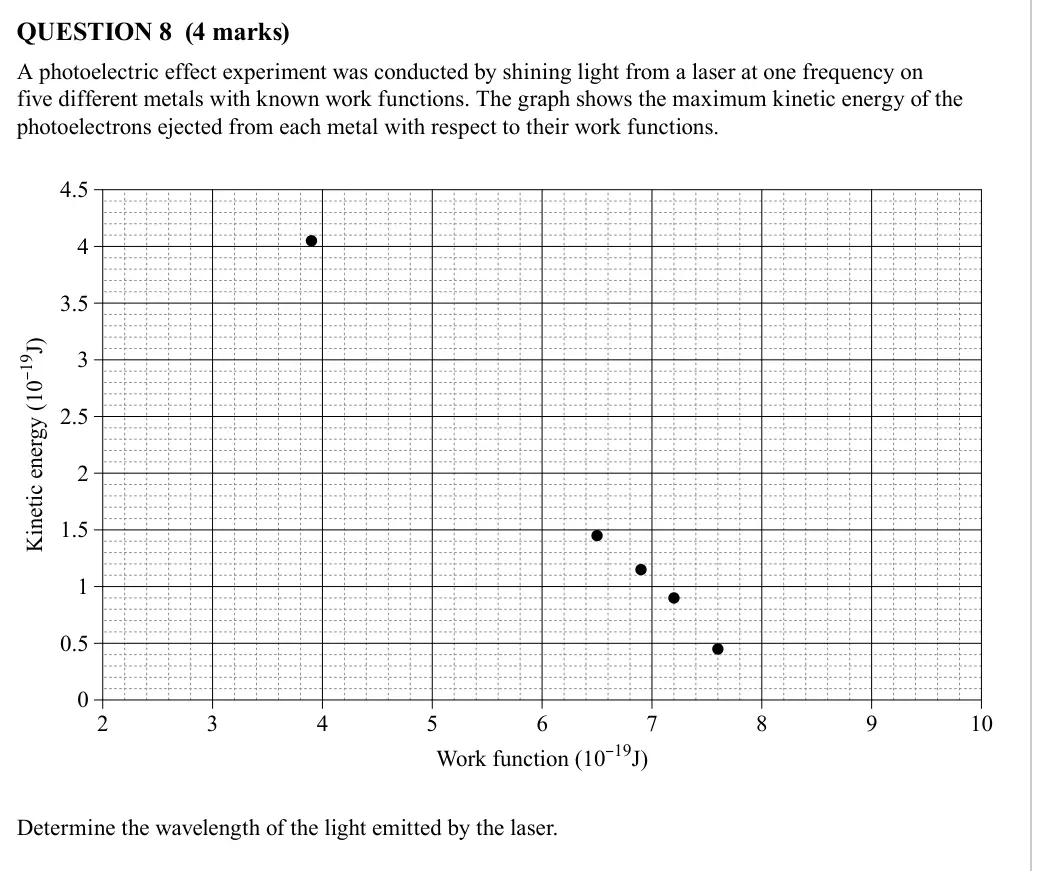
QUESTION 8 (4 marks) A photoelectric effect experiment was conducted by shining light from a laser at one frequency on five different metals with known work functions. The graph shows the maximum kinetic energy of the photoelectrons ejected from each metal with respect to their work functions. Kinetic energy (10–19J) Work function (10–19J) 0 2 3 4 5 7 6 8 9 10 0.5 1 1.5 2.5 3.5 2 4.5 3 4 Determine the wavelength of the light emitted by the laser. Wavelength = nm (to the nearest whole number)

QUESTION 9 (3 marks) Explain how Young’s double slit experiment provides evidence for the wave model of light.
Sua nota
0 / 32
Escritas: 0 pontos em 0 de 9 questões autocorrigidas.